Why the Mercedes V-Class Beats SUVs for Group Travel
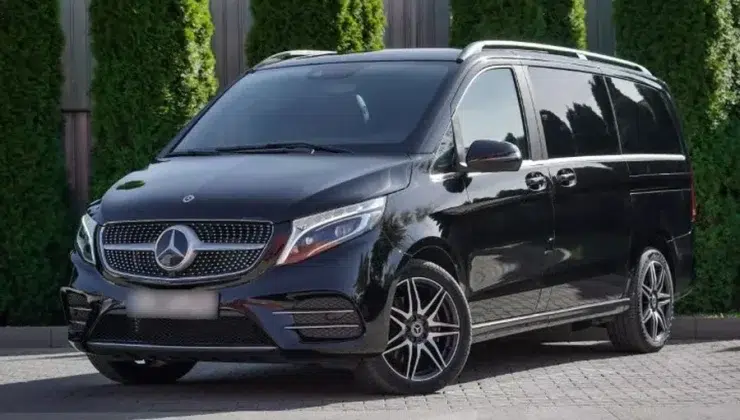
You’ve tried cramming 6-7 people into a luxury SUV. Someone’s knees hit the seat in front. Luggage doesn’t fit. The third row feels like punishment. I’ve rented both extensively, and the math changes when you look at what you get.
In this article, we will see when mercedes v class rent beats SUVs (and when not).
The Space Check
Here’s what rental companies don’t tell you: a “7-seater SUV” is marketing fiction. I learned this on a corporate trip with six executives and their roller bags. Two people volunteered to take an Uber rather than squeeze into that third row for three hours.
The V-Class Long gives you 1,030 liters of boot space with all seats up. While the X7 has only 750 liters. That’s 37% more cargo room.
Real measurements that matter:
- Third-row legroom in V-Class: 950mm (actual adult space).
- Third-row legroom in X7: 880mm (kids or short trips only).
- Second-row width in V-Class: Three adults sit without shoulders touching.
- Height advantage: Step in, don’t climb up.
The V-Class middle row swivels 180 degrees to face the rear. I’ve used this for client presentations during airport transfers. The seats lock into conference mode. Suddenly you’ve got a mobile boardroom.
You can’t do that in an SUV.
Cost Per Person Mathematics
A V-Class rental runs about €435 per day in Europe, $400-500 in major US cities. A Mercedes GLS costs $300-500 daily. Sounds cheaper, right?
Wrong. Here’s the breakdown:
| Vehicle | Daily Rate | Comfortable Seats | Cost Per Person |
| V-Class Long | €435 | 7 adults | €62 |
| Mercedes GLS | $450 | 5 adults (realistically) | $90 |
| Two BMW X5s | $600 combined | 8 adults | $75 |
I rented a V-Class for a week-long conference shuttle in Munich. Seven people, one vehicle, €2,355 total.
The alternative was two SUVs at €3,150 combined, plus the coordination headache of keeping two drivers in sync.
The fuel economy gap makes it worse:
- V220d returns 39.2 mpg.
- GLS manages maybe 21 mpg if you’re gentle.
- Over 500 miles, you spend an extra €80-100 on fuel with the SUV.
The SUV wins financially when you need serious towing capacity, carry only 4-5 people, or require off-road capability. Those scenarios are rare in luxury rentals.
The Luggage Problem Nobody Talks About
Volume specs lie. I’ve done the tetris game with suitcases in both vehicles. Shape matters more than cubic liter numbers. The V-Class has a flat, horizontal load floor. You stack bags like you’re packing a closet. Logical, efficient, accessible.
SUVs give you sloped, vertical space. It’s like stacking books on a slide. Bags tip over. You can’t reach the bottom without unloading half the pile. Nothing stays organized.
Business Travel Advantages
I use the V-Class for corporate airport transfers because it solves problems other vehicles create.
Last quarter, I picked up five board members from Frankfurt Airport. During the 40-minute drive to their hotel, they held an impromptu strategy session.
How it worked:
- The middle row swivels to face the rear seats.
- Folding tables deploy from the seats (built-in, not an afterthought).
- Everyone is connected to the onboard WiFi (handles 15 devices).
- Multiple USB-C ports meant nobody’s battery died mid-presentation.
Try that in a GLS. You can’t. The seats don’t swivel. There are no tables. People in the third row are too far away to participate in a conversation.
The professional image equation:
Electric sliding doors on both sides mean clients don’t fumble with handles or climb over each other. The Mercedes badge carries the same prestige as any S-Class. MBUX dual 12.3-inch screens and 64-color ambient lighting prove it’s not a van interior. It’s a Mercedes interior that happens to be spacious.
Airport logistics become stupid-simple. One vehicle, one driver, one pickup location.
The V-Class fits everyone, even when plans change.
The Comfort Factor
The Luxury 6-seat package changes the game. I rented one for a 600-mile corporate retreat drive. My client asked if we could extend the trip because the middle-row seats were “better than business class.”
These aren’t van seats with leather slapped on top. They’re the same seats from the S-Class, adapted for MPV use.
What you get in those middle seats:
- Full massage function with multiple programs.
- Individual climate control for each seat.
- Recline almost flat with an extending footrest.
- Heated and ventilated as standard.
Compare that to a GLS third row, where adult knees press into the seatback in front. The climate control is an afterthought.
Yes, the V-Class is louder at highway speeds than a luxury sedan. The diesel engine makes itself known, especially under acceleration. But it’s not van-loud anymore. Mercedes added substantial sound deadening.
During normal cruising at 70 mph, conversation happens at normal volume. The Burmester sound system compensates nicely when you want music.
The ride quality surprised me. It’s van-based, so there’s more body roll than an SUV on twisty roads. But the suspension tuning is pure Mercedes. It absorbs rough pavement without harsh impacts.
On the autobahn at 80 mph, it tracks straight and feels stable.
What SUVs Do Better
I’m not going to pretend the V-Class wins every comparison. It doesn’t.
When to choose the SUV instead:
- You’re towing a 7,000+ lb trailer (GLS maxes at 7,700 lbs vs. V-Class at 5,500 lbs).
- Off-road capability matters: the V-Class is rear-wheel drive and will beach itself on moderate trails.
- Driving dynamics are a priority: SUVs corner flatter and feel more like cars.
- Image concerns: some clients perceive SUVs as higher status than MPVs.
- You’re only carrying 4-5 people and prefer the SUV seating position.
The X7 and GLS drive better on mountain roads. They feel more planted, more responsive, more engaging if you care about that.
The V-Class drives like what it is a well-engineered people mover that prioritizes comfort over sport.
The Bottom Line
For actual 6+ person travel with luggage, the V-Class solves problems SUVs create. I’ve done both dozens of times. One requires compromises: who sits in back, whose bag stays at the hotel, can we all fit. The other doesn’t. Your choice depends on whether you prioritize how the vehicle looks from outside or whether everyone’s comfortable when you arrive.