Video Is No Longer a Marketing Asset — It’s Infrastructure
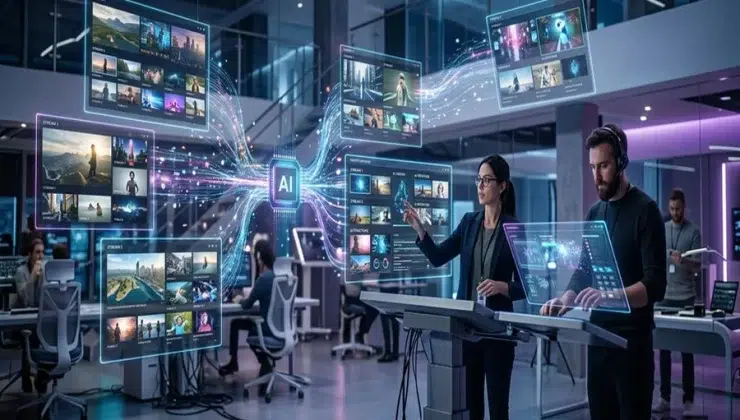
Why Every Business Now Behaves Like a Media Company
Most companies still treat video production as a marketing tactic. The data suggests that assumption is already obsolete.
Video is becoming operational infrastructure for modern growth — influencing discoverability, conversion, trust, retention, and market authority simultaneously. Businesses are no longer competing only on product quality or pricing; they are competing on their ability to consistently capture and sustain attention.
That shift is measurable.
Cisco projected that video would account for 82% of all internet traffic globally, a figure that reflects how deeply video has embedded itself into digital behavior. YouTube processes more than 500 hours of uploaded video every minute, while TikTok users spend close to an hour per day on the platform on average. Digital ecosystems are now structurally video-native.
This changes the role of marketing entirely.
Historically, brands interrupted audiences with campaigns. Today, they must earn attention continuously through publishing behavior. That is why companies increasingly resemble media organizations: they are required to produce ongoing streams of educational, narrative, and trust-building content simply to remain visible.
According to Wyzowl, 91% of businesses now use video as a marketing tool, while 96% of marketers say video has increased user understanding of their product or service, and 90% report that video directly generates leads. Video is no longer a support function — it is a performance channel.
The strategic shift is simple:
Marketing is now increasingly executed through video, not just supported by it.
Search Engines Are Becoming Trust Engines
SEO strategy is undergoing structural change.
Traditional optimization focused on technical inputs: keywords, backlinks, metadata, and domain authority. Those remain relevant, but search systems are increasingly evaluating behavioral trust signals — engagement depth, repeat visits, branded search activity, and cross-platform authority.
Video directly influences those signals.
Wistia reports that viewers spend on average 2.6x more time on pages with video than those without it. Forrester has also estimated that pages with video are 53 times more likely to appear on Google’s first page, largely due to engagement and relevance signals.
This is not just a technical ranking advantage. It is a behavioral one.
Video increases the likelihood that users understand, trust, and retain information. That changes how search engines evaluate content quality — not just by what is published, but by how users respond to it.
At the same time, search behavior itself is shifting. YouTube functions as the world’s second-largest search engine, and platforms like TikTok are increasingly used for product discovery, tutorials, and recommendations — particularly among younger audiences.
Search is no longer confined to text-based engines. It is distributed across video platforms, social feeds, and AI-driven discovery systems.
The implication is clear:
The future of SEO will not belong to the most optimized pages — but to the most trusted, most visible, and most consistently present brands across formats.
Brand Authority Is Becoming Frequency-Driven
A persistent misconception in marketing is that production quality is the primary driver of authority.
It is not.
Consistency now outweighs polish.
Audiences conditioned by creator platforms, podcasts, and founder-led media interpret repetition as credibility. A brand that publishes clear, consistent video insights weekly often appears more authoritative than one that produces highly polished campaigns once per quarter.
The data supports this shift.
HubSpot reports that short-form video delivers the highest ROI of any social content format. LinkedIn data shows video content generates 5x more engagement than static posts, while live video generates up to 24x more engagement than pre-produced formats.
Engagement is not just a vanity metric — it compounds visibility and reinforces perceived relevance across platforms.
Consumer trust data reinforces this dynamic. According to Brightcove, 88% of consumers say video has convinced them to purchase a product or service, while Wyzowl reports that 89% say video quality directly impacts trust in a brand.
Video compresses multiple trust signals into a single medium:
- expertise
- tone of voice
- leadership presence
- emotional clarity
- social proof
Written content demonstrates knowledge. Video demonstrates knowledge and conviction.
That distinction explains why founder-led and executive-led video strategies are becoming central to modern brand building.
The Most Effective Companies Are Building Media Operations, Not Campaigns
Many organizations still operate under a broadcast-era production model: centralized teams, quarterly campaigns, long approval cycles, and agency-dependent execution.
That structure is increasingly misaligned with how attention behaves.
Attention now moves in real time. Industry narratives shift daily. Relevance windows shrink. A six-week production cycle often means a company enters the conversation after it has already moved on.
Competitive advantage is shifting from production scale to production agility.
This is why companies are rapidly internalizing video capabilities. Wistia reports that more than half of marketers now produce video primarily in-house, reflecting a broader shift toward operational control and speed.
Meanwhile, platform-level consumption continues accelerating:
- YouTube Shorts: 70+ billion daily views
- TikTok: 1+ billion monthly active users
- LinkedIn video: consistent year-over-year growth
- Podcast/video hybrid formats: continued global expansion
These figures reflect a unified trend: audiences are fragmenting across video-first environments.
Leading organizations respond with structural changes:
1. Distributed Expertise
Expertise is no longer centralized in marketing teams. Engineers, product leaders, consultants, and customer success teams increasingly function as public educators.
This increases both authenticity and content scalability.
2. Modular Content Systems
Content is no longer produced as standalone assets. It is designed as reusable material ecosystems.
A single recording can become:
- long-form video
- short-form clips
- blog articles
- newsletters
- sales enablement content
- SEO assets
The goal is not volume — it is surface area.
3. Distribution-Native Strategy
Content is now designed for platforms from the start.
YouTube rewards search intent and retention. LinkedIn rewards professional framing and engagement. TikTok rewards immediacy and narrative hooks. Search rewards clarity and dwell time.
Each environment demands different creative logic.
Visibility Is Becoming a Structural Business Function
The next generation of market leaders will not simply market more effectively.
They will communicate more continuously.
Visibility is no longer a campaign outcome — it is becoming operational infrastructure. Companies that cannot consistently publish, explain, and distribute insight risk becoming invisible regardless of product strength.
This shift is already reflected in global media spending patterns, with digital video advertising continuing to outpace traditional television, and creator-driven ecosystems increasingly shaping consumer and enterprise perception.
Within the next decade, companies without internal media capabilities will face a disadvantage similar to businesses that once operated without websites or digital commerce infrastructure.
Marketing departments are evolving into editorial organizations. Executives are becoming public communicators. SEO is converging with audience development. Brand strategy is merging with publishing strategy.
This convergence is also reshaping the role of the modern video production and marketing company. The most valuable partners are no longer simply production vendors executing isolated campaigns. They are becoming strategic media operators — helping brands develop content ecosystems, editorial workflows, distribution strategies, and scalable publishing systems designed for long-term visibility.
Video sits at the center of this transformation because it is the most efficient format for combining discoverability, authority, trust, and scalability into one medium. A single well-executed video can simultaneously improve search performance, increase engagement metrics, strengthen executive presence, generate social distribution, and create reusable content assets across multiple channels.
This is why forward-looking businesses are investing less in one-off productions and more in continuous content infrastructure. According to HubSpot, companies prioritizing consistent video publishing report significantly higher engagement and lead generation performance than those relying primarily on static content or campaign-based media strategies.
The strategic question is no longer whether video matters.
The question is whether organizations are prepared to operate like media companies in a market where attention itself has become the primary competitive asset — and whether their internal teams and agency partners can deliver the level of strategic video production and digital marketing required to sustain visibility, authority, and growth at scale.