How AI Is Reshaping Everyday Work for Knowledge Professionals
Modern knowledge work involves much more than writing documents or answering emails. A typical professional may switch between search engines, messaging apps, meeting notes, cloud documents, creative tools, and project management software dozens of times throughout the day. While digital tools have improved productivity, they have also introduced fragmented workflows that make it harder to stay focused.
Artificial intelligence is beginning to reduce this complexity. Rather than replacing human expertise, AI assistants are increasingly helping people organize information, summarize content, generate ideas, and complete routine tasks more efficiently. As organizations continue adopting digital-first workflows, the conversation is shifting from whether to use AI to how it can fit naturally into everyday work.
AI Assistants Are Becoming Part of Modern Workflows
The rapid evolution of generative AI has expanded the role of intelligent assistants far beyond simple chat interfaces. Today’s systems can summarize lengthy documents, organize research, draft emails, generate reports, assist with brainstorming, analyze files, and support creative projects from a single conversation.
This reflects a broader shift toward connected workflows instead of isolated software tools. Rather than opening separate applications for writing, research, document analysis, and creative tasks, many professionals now prefer integrated AI workspaces that reduce unnecessary context switching.
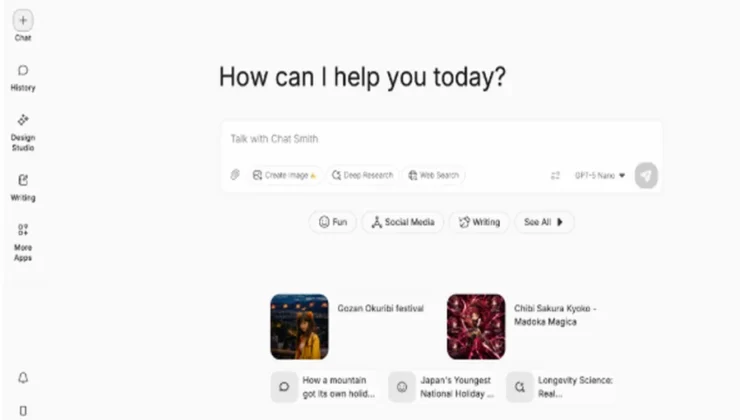
One example is AI chat platforms such as Chat Smith, which combine conversational AI with writing assistance, research support, document analysis, image generation, and other productivity tools within a unified workspace. By bringing multiple capabilities together, users can move more naturally from gathering information to creating and refining their work without repeatedly changing applications.
Practical Business Applications Continue to Expand
AI assistants are now being used across marketing, software development, education, customer support, consulting, and internal business operations.
Marketing teams use AI to generate campaign ideas, summarize research, and draft content more efficiently. Software developers rely on AI to explain code, troubleshoot problems, and accelerate documentation. Educators and students use AI to organize information and simplify complex topics, while business professionals increasingly depend on AI to summarize meetings, review documents, and prepare presentations.
Rather than replacing professional expertise, AI reduces repetitive work and allows people to focus more on decision-making, creativity, and collaboration.
What Makes an Effective AI Assistant?
As AI tools become more common, choosing the right assistant is becoming less about finding the most powerful language model and more about finding a platform that fits naturally into daily workflows.
An effective AI assistant should be able to:
- Understand context across different tasks.
- Support writing, research, brainstorming, and knowledge management.
- Reduce the need to switch between multiple applications.
- Help users organize information instead of simply generating text.
- Keep people in control of important decisions and creative direction.
Modern platforms increasingly combine multiple leading AI models with specialized tools for writing, research, document analysis, translation, image generation, and creative collaboration. This integrated approach enables professionals to complete more of their work within a single environment instead of relying on separate tools for every task.
The Future of Knowledge Work Is Collaborative
The next phase of AI adoption is likely to focus less on automation alone and more on collaboration between people and intelligent systems.
Organizations are placing greater emphasis on transparency, privacy, governance, and responsible AI adoption. At the same time, professionals are looking for tools that support existing workflows rather than forcing entirely new ways of working.
Platforms such as Chat Smith reflect this direction by combining multiple leading AI models with productivity-focused features in a unified workspace. Instead of treating AI as a standalone chatbot, integrated platforms are helping users manage research, writing, brainstorming, document analysis, and creative work through a connected experience that keeps human judgment at the center of the process.
Conclusion
Artificial intelligence is becoming an increasingly valuable part of modern knowledge work, helping professionals organize information, communicate more effectively, and complete everyday tasks with greater efficiency. The greatest value of AI isn’t replacing expertise—it is reducing the friction between thinking and execution, allowing people to spend more time on strategy, creativity, and meaningful decision-making.
As AI continues to evolve, integrated workspaces such as Chat Smith demonstrate how conversational AI, knowledge management, and creative tools can work together to simplify everyday workflows while keeping people firmly in control of the ideas that matter most.