Photo Food Logging vs Manual Entry: Which Works Better?
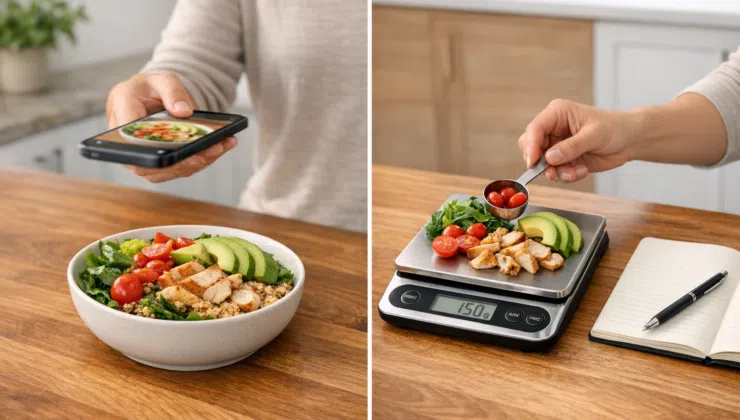
Photo food logging is faster and more accurate than manual entry for most people, especially for weight loss and consistent tracking. Manual entry, however, offers unmatched precision for those needing detailed nutrient data, like athletes or individuals managing medical conditions. Here’s a quick breakdown:
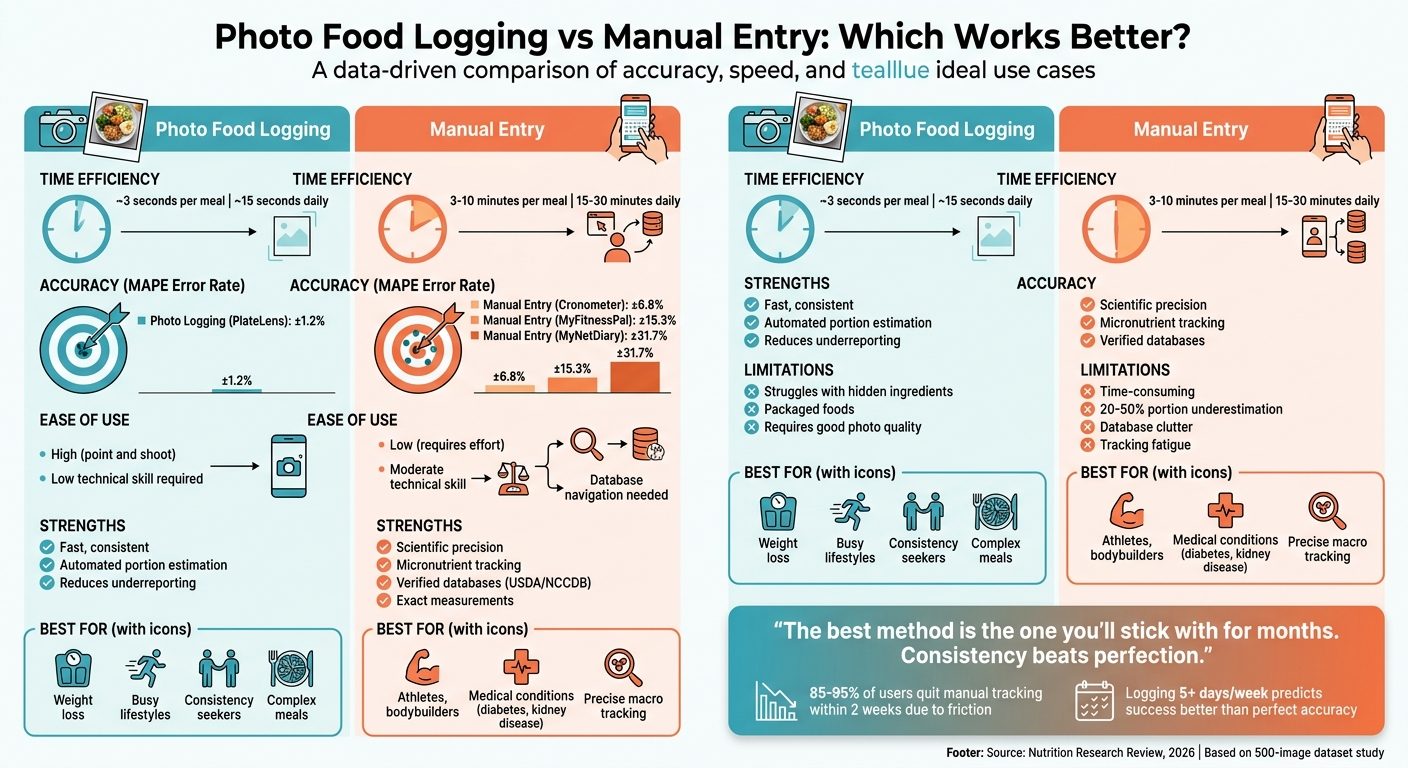
- Photo Logging: Takes ~3 seconds per meal, uses AI to estimate portions, and has a low error rate (~±1.2%). Struggles with hidden ingredients or packaged foods.
- Manual Entry: Takes 15–30 minutes daily, relies on user input and food scales, and can be more precise for specific nutrients. Prone to errors from portion misestimation and memory lapses.
Key Findings:
- AI tools like PlateLens outperform manual apps like MyFitnessPal in accuracy (±1.2% vs. ±15.3%).
- Photo logging is better for saving time and encouraging consistency.
- Manual entry is ideal for those needing precise control over their diet.
Quick Comparison:
| Feature | Photo Logging | Manual Entry |
| Time per Meal | ~3 seconds | 3–10 minutes |
| Accuracy | ±1.2% (AI tools) | ±6.8%–±31.7% |
| Ease of Use | High (point and shoot) | Low (requires effort) |
| Hidden Ingredients | Must add manually | Can be accounted for |
| Best For | Weight loss, speed | Athletes, precision |
For most users, photo logging offers a simpler, faster way to track meals, while manual entry remains the go-to for detailed tracking needs.
I Tested AI Calorie Scanners… Most Were WRONG
How Photo Food Logging Works
Photo food logging transforms your smartphone camera into a handy nutrition tracker. You simply snap a photo of your meal, and within moments, the app identifies the food items and estimates their calories and macronutrients. This is made possible by advanced deep learning models like ResNet, EfficientNet, or Vision Transformers that analyze food images.
The process begins with the AI identifying food items by drawing bounding boxes around them and classifying them based on visual features. Next, it estimates portion sizes using plate-size references, 2D depth estimation, and statistical averages (e.g., a typical chicken breast weighs between 120–200 grams). Once the food is identified and sized, the app cross-references this information with verified nutritional databases like USDA FoodData Central to calculate calorie and macronutrient values.
The most effective systems let you review and correct the AI’s suggestions, treating its output as a draft rather than a definitive record. This “human-in-the-loop” approach is crucial because while AI can achieve low error rates (as little as 3%) for straightforward foods like grilled chicken, it struggles with complex dishes. For example, meals like curry can have hidden ingredients – like cooking oil – that lead to errors exceeding 40%. These core processes form the backbone of the cutting-edge AI technology discussed below.
AI Technology in Food Recognition
Top AI systems have made impressive strides in food recognition. By 2026, leading models achieve 85%–95% first-guess accuracy for common foods in well-lit photos, with a mean absolute error of 10%–15% under controlled conditions. However, accuracy can vary depending on the type of food. A February 2026 study published in Nutrition Research Review found that PlateLens had a mean absolute percentage error of only ±1.2%, while manual-entry tools like MyFitnessPal showed errors ranging from ±12.4% to ±31.7%. PlateLens’s precision with restaurant meals and mixed dishes is attributed to its advanced depth estimation algorithms.
Despite these advancements, there are still challenges. AI struggles to detect “invisible” calories from ingredients like cooking oils, butter, or dressings absorbed into the food, requiring users to add these manually for better accuracy. Additionally, many models are trained primarily on Western diets, leading to higher error rates for certain dishes. For instance, beef pho might be overestimated by 49%, while bubble tea could be underestimated by 76%. However, newer smartphones equipped with LiDAR and depth sensors are starting to address these issues by measuring food volume more accurately, reducing reliance on algorithmic estimations.
Photo Food Logging Apps and Tools
A variety of apps bring this AI-driven technology to users in practical and accessible ways.
Welling is one such app that uses AI-powered photo recognition to simplify calorie tracking. Snap a picture of your meal, and the app analyzes it against a global food database to estimate calories and macronutrients. It also provides real-time feedback, which you can adjust via a chat interface.
Other popular tools include some of the best AI nutrition apps like Bitesnap and Calorie Mama AI, both praised for their quick food recognition and ability to encourage consistent tracking. For those looking for added convenience, FoodBuddy offers a premium subscription at $39.99 per year, combining photo logging with voice-powered tracking – great for situations where snapping a photo isn’t practical. Most of these apps include a free version with basic features, alongside premium tiers priced at around $39.99 annually.
For the best results, ensure your photos are clear by taking them from a top-down or 45-degree angle under natural daylight or bright artificial lighting. Keeping food items separated on your plate can also improve accuracy.
How Manual Entry Food Logging Works
Manual food logging involves typing in the name of each food item, selecting it from a database, and entering the portion size. This often means weighing your food with a kitchen scale or estimating portions using measurements like cups, tablespoons, or general sizes such as “small”, “medium”, or “large.” If your app doesn’t include a specific food – like a homemade meal – you might need to log each ingredient separately or manually input nutritional details from a product label or an external resource like the USDA database. Compared to the best food calorie apps using AI, this process requires more effort and is more prone to errors.
For dishes with multiple components, accuracy depends on breaking down the meal into individual ingredients. For example, instead of logging “Chicken Stir Fry” as one item, you’d need to enter the chicken, vegetables, oil, and sauce separately. Cooking methods also matter – grilled chicken has a different nutritional profile than fried chicken. Just adding one tablespoon of cooking oil can contribute about 119 calories. Studies show that people forget 20–30% of what they eat within hours, so logging immediately – or snapping a quick photo for reference – can help reduce errors.
One of the biggest hurdles with manual entry is estimating portion sizes. Without a food scale, it’s easy to underestimate servings by 30–50%. A “tablespoon” of peanut butter, for example, might actually be closer to two tablespoons when eyeballed, sneaking in an extra 90–100 calories. This challenge contributes to manual-entry platforms having a Mean Absolute Percentage Error (MAPE) ranging from ±12.4% to ±31.7%. Cronometer, with its verified database, shows a lower error rate of ±6.8%, while MyNetDiary tends to have higher inaccuracies.
Manual Entry Platforms and Apps
MyFitnessPal is one of the most popular manual-entry apps, boasting a massive database with over 14 million food items and a barcode scanner for convenience. However, this large database can lead to “database fatigue”, where a search for something as simple as “chicken breast” yields dozens of conflicting options. On the other hand, Cronometer offers a more precise approach by using only verified, lab-tested data from sources like the USDA and NCCDB. While this ensures accuracy, its interface can feel more time-intensive.
Other apps, like Lose It!, combine manual entry with photo logging and maintain a MAPE of around ±12.4%. Noom, another option, scored 4.44 out of 5 on the Mobile App Rating Scale. Many of these platforms now integrate AI features, such as natural language processing, allowing users to describe meals via text or voice instead of manually searching for entries. Despite these advancements, manual logging still struggles with accuracy and ease of use.
Common Problems with Manual Data Input
Logging food manually can take 15–30 minutes daily, which is why many users abandon the process within two weeks. This inconvenience is the top reason people stop tracking their meals. Beyond the time commitment, errors in logging lead to calorie under-reporting, which ranges from 4.7% to 14.6% on average.
Crowdsourced databases further complicate things, as they often include duplicate or conflicting entries, leaving users to guess which one is correct. The inter-rater reliability of these apps is moderate, with an Intraclass Correlation Coefficient (ICC) of 0.71 to 0.84, reflecting the subjectivity of portion estimation. Additionally, people tend to underestimate their calorie intake by an average of 47% when relying on memory. Hidden ingredients like cooking oils, butter, and dressings – which are often overlooked – can add hundreds of unaccounted-for calories.
Accuracy Comparison: Photo vs Manual Entry
Research Findings on Logging Methods
When it comes to tracking what you eat, accuracy plays a major role in effective nutrition tracking. A systematic review published in February 2026 in Nutrition Research Review put seven popular food tracking apps to the test using a dataset of 500 images. The results highlight the precision of AI-powered tools, with PlateLens leading the pack. Its Mean Absolute Percentage Error (MAPE) was just ±1.2%, far ahead of Cronometer (±6.8%), MyFitnessPal (±15.3%), and MyNetDiary (±31.7%). The study emphasized that AI-driven volumetric analysis reduces cognitive biases often found in manual logging.
“The primary source of error in manual dietary assessment is portion size estimation rather than food identification per se.”
Hayes J., Santos M., Chen D., Nutrition Research Review
The research also uncovered a directional bias in manual tracking. Manual apps tend to underestimate calorie intake, with errors ranging from –4.7% to –14.6%. Additionally, the bias varies by diet type: Western diets are overestimated by 1,040 kJ, while Asian diets are underestimated by 1,520 kJ.
Another key finding was the higher reliability of AI-based tools. AI methods achieved an inter-rater reliability score (ICC) of 0.97, compared to the 0.71–0.84 range seen in manual methods. The table below captures the accuracy metrics and bias trends for leading food tracking apps.
Accuracy Metrics Comparison Table:
| Application | Method Type | MAPE (Error Rate) | Bias Direction |
| PlateLens | AI Photo Recognition | ±1.2% | –0.3% (Under) |
| Welling | AI Photo & Chat | Data Unavailable | Data Unavailable |
| Cronometer | Manual Entry | ±6.8% | +2.1% (Over) |
| Lose It! | Manual / Photo | ±12.4% | –4.7% (Under) |
| MyFitnessPal | Manual Entry | ±15.3% | –6.2% (Under) |
| Lifesum | Manual Entry | ±18.7% | –7.9% (Under) |
| Noom | Guided Entry | ±22.1% | –9.3% (Under) |
| MyNetDiary | Manual Entry | ±31.7% | –14.6% (Under) |
Convenience and Time Efficiency
When juggling work, family, and fitness, the time spent tracking your meals can be just as important as getting the numbers right. The team at CalorieCue puts it plainly:
“The method matters as much as the act. Traditional calorie tracking… takes 15–30 minutes per day. That level of friction kills consistency.”
With AI photo scanning, logging a meal takes roughly 3 seconds – around 15 seconds for an entire day. Compare that to manual entry, which can take 3–10 minutes per meal due to the need for detailed searches and manual inputs, adding up to 15–30 minutes daily. This stark contrast in time requirements plays a big role in how consistently people stick to tracking and how accurate their entries are.
Why Time Savings Matter
The difference in time investment directly impacts long-term adherence. Research shows that manual logging is one of the main reasons people quit food tracking within two weeks. By cutting down the time required, automating your weight loss tracking helps users stay consistent – a key factor in successful dietary tracking. The constant effort of searching and weighing in manual entry takes a toll, leading to fatigue that can reduce accuracy. Photo logging sidesteps these challenges by automating complex steps like identifying foods and estimating portion sizes.
Timing also plays a role. Immediate photo logging – taking a quick snap before eating – reduces the risk of memory-based errors that often occur with delayed manual entry. While manual tracking does allow post-meal flexibility, this delay can compromise accuracy.
Convenience Factors Comparison Table:
| Factor | AI Photo Logging | Manual Database Entry |
| Time per Meal | ~3 seconds | 3–10 minutes |
| Total Daily Time | ~15 seconds | 15–30 minutes |
| Effort Level | Low (Point and shoot) | High (Search, select, weigh) |
| Technical Skill Required | Low (Basic camera use) | Moderate (Database navigation) |
| Portion Estimation | Automated (AI-driven) | Manual (User-estimated) |
| Logging Flexibility | Must capture before eating | Can log any time after meal |
| Long-term Sustainability | High (Low friction) | Low (High quit rate) |
Pros and Cons of Photo Food Logging
Photo food logging stands out for its convenience and speed, but it also comes with some notable challenges. This method allows users to document meals in mere seconds, cutting down on the time and mental effort required for traditional manual logging. While it’s a game-changer in many ways, it’s not without its flaws, as outlined below.
One of the biggest advantages is its ability to estimate portions more accurately than manual methods. By using advanced AI technologies like volumetric analysis and depth estimation, it can calculate serving sizes with impressive precision. These automated systems also tend to have lower error rates and reduce the underreporting issues often seen in manual food tracking.
That said, there are some limitations. One major issue is visibility. The AI might miss ingredients that are hidden – like those wrapped inside a burrito, masked by a thick sauce, or blended into a casserole. Another challenge involves calorie-dense ingredients, such as butter or cooking oils, which might not be visible in the photo. Additionally, the quality of the photo plays a significant role in accuracy. Poor lighting or awkward angles can throw off the system’s calculations.
Packaged foods present another hurdle. While the technology works well for home-cooked meals and plated dishes, barcode scanning remains a more reliable option for branded items. Furthermore, the accuracy of photo logging can vary greatly depending on the app being used, leading to inconsistent results.
Photo Logging Pros and Cons:
| Pros | Cons |
| Fast Logging: Captures meals in seconds instead of minutes | Visibility Issues: Misses hidden ingredients or those masked by sauces |
| Less Mental Effort: Eliminates the need for manual searching | Photo Quality Matters: Accuracy depends on good lighting and angles |
| Portion Precision: Uses AI for accurate serving size estimation | Packaged Foods: Less reliable than barcode scanning for branded items |
| Encourages Consistency: Easier to stick with over time | App Variability: Accuracy differs across AI platforms |
| Minimizes Bias: Reduces underreporting common in manual logs | Complex Meals: Struggles with mixed dishes or hidden components |
Pros and Cons of Manual Entry
Manual entry provides a level of precision that’s hard to match with photo logging. This is largely because it relies on verified databases like the USDA and NCCDB. For example, apps such as Cronometer excel in tracking detailed micronutrient data – covering vitamins, minerals, omegas, and amino acids – details that AI-based systems often don’t include. This makes manual entry particularly useful for athletes or those adhering to specific medical diets. It also allows users to log exact weights in grams or ounces and specify whether food is raw or cooked, giving them complete control over their tracking.
That said, this precision comes with its challenges. Manual entry can be both time-intensive and prone to errors. A systematic review highlighted that portion estimation is a major source of mistakes in manual tracking systems. As Mickey Kittinuttakul from Welling.ai explains:
“Portion estimation is the #1 cause of user error in food tracking.”
Mickey Kittinuttakul, Welling.ai
On average, people underestimate their caloric intake by 20% to 50% when relying on estimates rather than using a scale. Additionally, memory plays a role – users can forget 20% to 30% of their meals within just a few hours.
Another downside is database clutter. Take MyFitnessPal, for instance: its massive, user-generated database often has multiple entries for the same food. One banana might be listed at 80 calories, while another is 120 calories, leaving users to sift through conflicting options. Combined with the time required and reliance on memory, this friction often leads to tracking fatigue. Many users may skip logging snacks or abandon tracking altogether within a few weeks. This is why many people look for proven weight loss strategies that prioritize sustainability over rigid manual counting.
While manual entry does allow for logging meals after eating – something photo logging can’t do if you forget to take a picture – this advantage fades if you can’t remember what you ate. For someone aiming for a daily calorie deficit of 500 calories, even a ±15% error rate could result in a ±300-calorie swing, completely undermining their goal. So, while manual entry offers unmatched detail, its drawbacks highlight why many people turn to photo logging for ease and efficiency.
Manual Entry Pros and Cons:
| Pros | Cons |
| Scientific Precision: Relies on verified USDA and NCCDB databases | Time-Consuming: Requires significant effort |
| Micronutrient Detail: Tracks vitamins, minerals, and amino acids | Portion Errors: Estimates often lead to 20–50% underreporting |
| Exact Measurements: Log precise weights (grams/ounces) and food states | Database Clutter: Crowdsourced entries can be inconsistent |
| Logging After Eating: Allows retrospective logging, unlike photo methods | Tracking Fatigue: High effort can lead to skipped entries or quitting |
| Recipe Integration: Works well with structured meal plans and pre-measured ingredients | Memory Decay: Forgetting 20–30% of intake within hours is common |
| Massive Databases: Includes niche global and restaurant items | Systematic Bias: Underestimation bias ranges from -4.7% to -14.6% |
Choosing Between Photo Logging and Manual Entry
Deciding between photo logging and manual entry depends on your goals, daily habits, and how precise you need to be. Let’s break it down based on different scenarios.
If your focus is weight loss, AI-powered photo logging is often the smarter choice. Why? It cuts down on what experts call “tracking friction.” In other words, it makes the process so fast – around 3 seconds per meal – that you’re more likely to stick with it. And when it comes to weight loss, consistency is key. Pairing this with fat-burning exercises can further accelerate your progress. As the CalorieCue Team explains:
“The goal isn’t to find the ‘best’ method in theory – it’s to find the method you’ll actually stick with for months.”
On the other hand, if you’re managing a condition like kidney disease or diabetes – or if you’re a competitive athlete or bodybuilder – manual entry with a food scale is better. This approach delivers medical-grade precision, with an accuracy margin of ±5%. That level of detail is crucial when you’re tracking specific macros or micronutrients.
Here’s why precision matters: Manual entry errors can easily reach ±15%, which could translate to a ±300-calorie discrepancy per day. That’s enough to cancel out a typical 500-calorie deficit. Meanwhile, advanced AI tools like PlateLens are far more accurate, with an error margin of just ±24 calories per day. If you’re pressed for time or find consistency challenging, AI photo scanning is the better option.
In short, the right method depends on what you need:
- Manual entry with a food scale: Best for athletes, bodybuilders, or anyone who needs precise nutrient tracking.
- AI photo scanning: Ideal if you struggle with consistency, eat complex meals, or want to save time.
- Hand method: A rough backup for maintenance phases, using your palm and fist to estimate portions. Keep in mind, though, that its accuracy drops to ±25–40%.
Using Both Methods Together
To address the downsides of relying on just one method, many users now opt for a hybrid approach. By combining photo logging with manual entry, you can strike a balance between speed and accuracy.
This approach takes advantage of the strengths of each method. For example, you could snap a quick photo of your meal for an AI-based estimate, then manually fill in any missing details. As Biteme explains:
“The secret sauce isn’t picking just one method. It’s figuring out how to mix and match them so you get accurate results.”
This blend offers the efficiency of AI while ensuring the precision of manual tracking.
Here’s how you can make it work: Use photo logging for complex or mixed meals, and barcode scanning for packaged foods to pull in verified nutritional data. For meals you prepare often, weigh the ingredients once to determine portion sizes, then rely on photo logging for quicker entries in the future.
Modern apps make it easier to integrate these methods seamlessly. Tools like Welling, Nutrola, and Biteme combine AI and manual features in a single platform. Welling, for instance, allows users to log meals by snapping a photo or typing something like, “I had a chicken salad with avocado.” It also includes access to verified databases for those moments when precision matters most. As Welling’s CPO, Mickey Kittinuttakul, puts it:
“The app that removes the most friction tends to produce the most accurate long-term calorie logs.”
Mickey Kittinuttakul, CPO, Welling.ai
This hybrid method not only boosts accuracy but also encourages consistency. Taking photos creates a visual record, which can help reduce the 20–30% underreporting that often happens when people delay logging their meals. On top of that, studies reveal that tracking meals at least five days a week is a better predictor of weight loss success than obsessing over perfect precision in every single entry.
Conclusion
We’ve explored speed, precision, and ease of use across various tracking methods. The takeaway? There’s no one-size-fits-all solution. The best choice depends on your goals, lifestyle, and how much precision you truly need.
If your focus is on weight loss or building healthier eating habits, photo logging is the simplest way to stay consistent. Apps like Welling (rated 4.8/5 in the App Store) reduce tracking time dramatically – from 15–30 minutes a day to just 3 seconds per meal. Since logging at least five days a week is key to success, minimizing effort is crucial. As Welling’s CPO Mickey Kittinuttakul explains:
“The most accurate calories tracking app is not always the most scientific. It’s the one users can log in consistently without friction. Accuracy fails when users stop logging.”
Mickey Kittinuttakul, CPO, Welling.ai
On the other hand, some users need more precision. Competitive athletes, bodybuilders, and those managing medical conditions like diabetes often benefit from manual logging with a food scale. This method can achieve ±5% accuracy, which is essential for hitting exact protein goals or monitoring specific nutrients.
For many, a hybrid approach strikes the right balance. Use photo logging for everyday meals to stay consistent, and switch to manual entry or barcode scanning for packaged foods when you need verified details. This flexibility helps you stick with tracking long term, and consistency is what ultimately leads to results.
FAQs
How can I make photo food logging more accurate?
To get better results with photo food logging, make sure your pictures are well-lit and clearly display the food. This allows AI systems to more effectively recognize items and estimate portion sizes. Apps like PlateLens, which feature advanced AI and extensive food databases, can improve the accuracy even further. The combination of clear images and dependable tools is essential for precise photo food logging.
When is manual food logging worth the extra time?
Manual food logging shines when you need precise control over your dietary tracking. Whether you’re monitoring exact quantities in grams, specific food brands, or detailed macro and micronutrient breakdowns, this method ensures accuracy. It’s especially helpful for those managing packaged foods or adhering to clinical nutrition plans where every detail matters. While photo-based AI tools may save time, manual logging is the go-to choice for anyone who values precision over convenience.
What’s the best way to combine photo logging and manual entry?
Combining photo logging and manual entry gives you a great mix of convenience and accuracy. Photo logging is perfect for snapping quick pictures of meals, especially when you’re dealing with complex dishes or eating out. On the other hand, manual entry works well when you want to track specific details like exact portion sizes, brands, or individual ingredients. Many apps make it easy to switch between these two methods, so you can stay efficient without losing track of the finer details – helping you stay on top of your health and fitness goals.