The Latest Variations and Applications of VR Technology
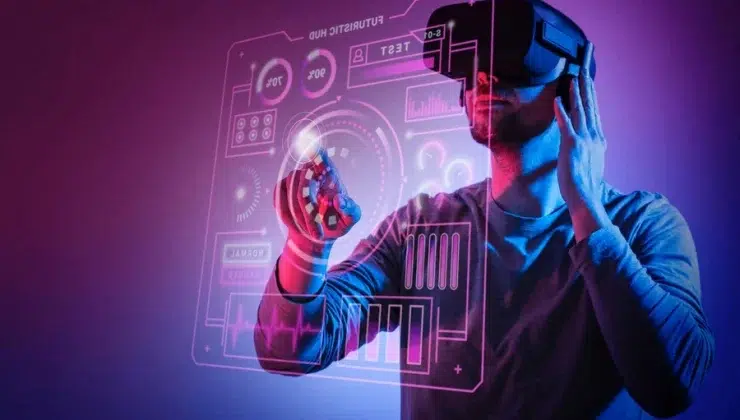
The origins of virtual reality technology remarkably reach back to the late 1960s. It was not until the ‘90s when headsets found their way to the mainstream that the consumer focus on VR began to ramp up.
Computer-generated rooms on a standard computer screen or mobile device have raced along, driven by improved graphics, chips, and online streaming. In contrast, the development of VR has been more of a slow march than a rapid progression of technology.
Yet the VR branch of technology has never gone away. Today, it thrives through state-of-the-art applications across a broad spectrum of industries, from education to medicine, and comes in three prime categories.
Fully-immersive
This is the version of virtual reality that most people will be attuned to. It can be thought of as a gaming setup through a dedicated headset. The stimulation levels and immersion are full, incorporating sights and sounds in a massive, high-resolution world.
Fully-immersive VR allows users to experience a 360-degree view of whatever world they are looking at. It’s that level of depth through the stereoscopic separate lenses that takes players as deep as the technology currently can. The gaming world has invested heavily in this sector and especially in brand-new gambling casinos, where you are likely to be able to fully immerse yourself in a casino environment for maximum realism.
While this is big in the world of gaming, there are other common uses, like therapeutic relaxation. It could be purposely taking someone out of the real world to go floating on an ocean to relieve stress, or to distract someone during the physical demands of the latter stages of childbirth.
Non-immersive VR
Most people will have experienced non-immersive virtual reality. Playing a video game on a console or computer exposes users to non-immersive VR. Because it has been around for so long, it’s not seen as being part of the virtual reality story arc.
But it is the starting point. It is viewing generated graphics on a screen, which allows a user to engage in a simulated, virtual reality. The operation in non-immersive VR comes through a joystick, a controller, or even a keyboard. The user is more in the real world than in the virtual world, therefore experiencing a non-immersive virtual reality experience.
Semi-immersive VR
This is the midway point of virtual reality, which has made it fantastic for educational and business training purposes. Being only semi-immersive, only a part of the user’s experience is digitally created.
The benefit of this over fully-immersive virtual reality technology is that the user can keep their bearings in the real world. A good way to think about this is a driving game at an arcade, where the visual output of the simulated 3D experience is focused and provides a lot of gaming depth and immersion.
The player sits in the game’s shell, grounded in the real world by steering and operating the foot pedals. The physical actions are influencing the virtual environment, but the player is not fully immersed; there is a separation.
Collaborative VR
Collaborative virtual reality is great for training as it is where several users experience the same virtual simulated environment at once. Everyone can plug in and explore the same experience and the other people’s avatars around them, learn, build and socialise together within the shared digital world.
Mixed reality
This is one of the newer elements to have come out of virtual reality. Mixed reality pulls together the virtual and real worlds, not so much as in a semi-immersive virtual reality but more as an augmented reality. Mixed reality is a blend of virtual and augmented reality. Think game avatars running around someone’s living room and interacting with furniture. Devices like Microsoft’s HoloLens and Apple’s Vision Pro are some examples of pretty groundbreaking tech.
Augmented reality
This has become a playground for marketers looking to push their branding, as well as gaming. Augmented reality can display virtual digital elements in the real world, most commonly through a smartphone camera and display.
Augmented elements supplement the real view of the world through a device. From games like Pokémon Go to apps that let you preview how different furniture will look in your room, it’s become a playground for gaming and marketing alike.
Main applications
Entertainment and gaming remain the most visible drivers of VR adoption, offering experiences like exploring ancient Rome or battling through a futuristic underworld. But the technology’s potential goes far beyond play.
In healthcare, VR is used for surgical training, phobia treatment, and physical rehabilitation. In education, immersive learning environments can place students inside historical events or scientific simulations. In architecture and design, AR and MR allow clients to walk through virtual buildings or visualize new layouts in real spaces.
Looking forward, the line between virtual and physical worlds will continue to blur. AI-driven environments will adapt dynamically to users, creating personalized simulations that evolve in real time. Advances in haptic technology promise to add the sense of touch, making interactions with digital objects feel physical. Hardware will also become lighter and more comfortable, with wearable glasses eventually replacing bulky headsets.
The future of VR, AR, and MR is not simply about escaping reality. It is about expanding human experience, providing new ways to learn, connect, and create.