How to Choose the Right Color for Your Halo Hair Extensions
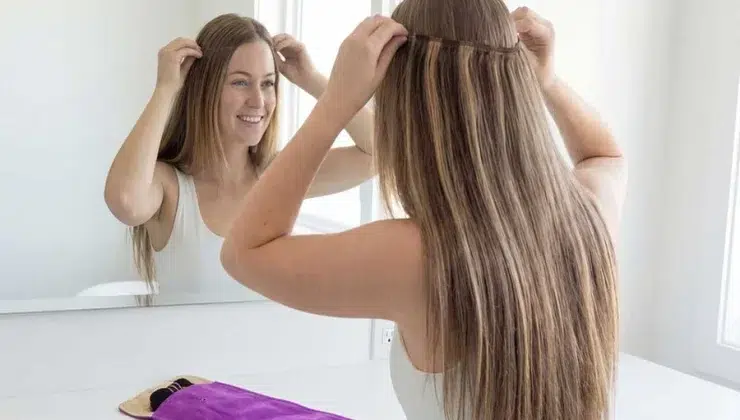
Choosing the right color for halo hair extensions sounds straightforward until you hold a shade next to your hair and realize it looks completely different under store lighting. A poor color match can make extensions look obvious and artificial, which defeats the whole purpose. The good news is that with a few smart strategies, you can find a shade that blends so naturally that no one will notice the difference. This guide walks you through everything you need to know, from matching your mid-lengths to understanding what to do between two shades.
Match to Your Mid-Lengths and Ends, Not Your Roots
One of the most common mistakes people make is holding a color swatch up to their roots and deciding from there. Your roots are almost always darker than the rest of your hair, so this approach leads to extensions that look too dark once they blend into your lengths.
Instead, focus on your mid-lengths and ends. These are the sections that will sit closest to your extensions, and a seamless blend at that level is what creates a natural, polished result. Hold the color swatch against the bottom half of your hair in indirect light to get an accurate comparison.
Natural daylight near a window gives you the truest read, since fluorescent and warm indoor bulbs shift tones and can trick your eye into picking a shade that’s too warm or too ashy. Whether you’re testing an invisible wire halo by ThatHair, a Halo Couture piece, or a Sitting Pretty Halo, lay the strand flat along your hair rather than holding it up, because weight and angle change how the color reads. Check the match in a few spots — front, sides, and back — since hair color rarely sits uniform across the head. Trust what you see when the piece is actually resting against your strands, not what you see in the packaging.
Understanding Undertones and Why They Matter
Color matching is not just about lightness or darkness. Undertones play a significant role in whether an extension looks like it grew from your head or was clipped in from a completely different person’s hair.
Hair undertones generally fall into three categories: warm (golden, red, copper), cool (ash, blue-gray), and neutral (a balance of both). If your natural hair has warm golden tones and you choose a cool ash extension, the contrast will be noticeable even if the depth of color is identical. Always identify your hair’s underlying tone before selecting a shade.
A practical approach is to look at your hair in natural daylight and notice what colors catch the light. If you see golden or reddish glints, your hair leans warm. If it appears more silvery or lacks any warm reflection, it leans cool. Matching undertone to undertone is the step most people skip, and it is often the reason a technically similar shade still looks off.
Single-Tone vs. Multi-Tonal and Balayage Extensions
Not all extensions are created equal in terms of color complexity. Single-tone extensions carry one consistent color throughout, which works well for hair that is naturally uniform in depth and tone. But most people’s hair is not truly one flat color. Natural hair has subtle variations, and a single-tone extension against multidimensional hair can look too flat or artificial.
Multi-tonal extensions mimic the natural variation found in real hair by blending two or more complementary shades within the same weft. These are a far better choice for anyone with highlighted, sun-kissed, or color-treated hair because the variation in the extension mirrors the variation in your own hair.
Balayage extensions take this a step further by replicating a gradient effect from a darker root area to lighter ends. If your hair has been balayage-treated or you have natural color variation that grows lighter toward the tips, a balayage extension set will blend far more convincingly than any single-tone alternative. The key is to match both the darker section of the extension to your mid-lengths and the lighter section to your ends.
How to Test Your Color Match Before Buying
The best color decisions come from deliberate testing rather than guesswork. Most quality extension brands offer color swatches or sample sets that you can order before committing to a full set. This small investment can save you from the frustration of a full return.
Using Natural Light and Multiple Environments
Indoor lighting is deceptive. Warm yellow bulbs make everything look golden, while cool office fluorescents can make hair appear more ashy than it actually is. To get an honest read on a color swatch, test it in at least two or three different light conditions.
Start in natural daylight, ideally outside or next to a window without direct sun. Then check it under indoor lighting to see how the tone shifts. Hold the swatch flat against your mid-lengths rather than over your roots, and look at it from a distance of about an arm’s length to simulate how others will see your hair. If the swatch still looks like a natural continuation of your color in all three environments, you have found your match. If it only looks right in one type of light, keep looking.
What to Do When You’re Between Two Shades
At some point, almost everyone lands in this exact situation: two shades, and your hair seems to fall somewhere in the middle. The instinct is to split the difference and go lighter, but that is not always the right call.
For most hair types, the general guidance is to go slightly darker rather than slightly lighter. A shade that is a touch darker than your ends tends to blend better once it falls into your hair because shadows and movement naturally break up any visible contrast. A shade that is too light, on the other hand, can look highlighted in a way that draws attention rather than blending in.
That said, if your hair is heavily highlighted or already very light at the ends, the lighter of the two shades is the safer direction. In both cases, consider whether a multi-tonal or blended shade from that brand might actually span both options in a single weft, which would eliminate the dilemma entirely. Some brands offer color-match consultations or return policies specifically for this reason, so take advantage of those resources before you finalize your order.
Conclusion
Color matching for halo hair extensions comes down to three things: match to your mid-lengths and ends, respect undertones, and test before you commit. Get these right, and your extensions will look like a natural part of your hair rather than an obvious add-on. Take your time with the process, use swatches, and trust what you see in natural light. A well-matched set of halo extensions can genuinely change the way your hair looks and feels every single day.