Air Operated Valve Working Principle: A Practical Guide
Bullet Intro (Hero Section — Expert Voice)
- As someone who installs and maintains industrial valves for a living, I’ve seen how air operated valves outperform manual and solenoid valves in heavy-duty environments. In this guide, I’ll walk you through what makes these pneumatic workhorses so reliable and where they shine.
- We’ll break down the core components — from the actuator that drives motion, to the valve body and air supply ports that make it all function under pressure.
- I’ll explain, step by step, how compressed air is transformed into mechanical movement — opening or closing the valve based on system demand.
- These valves are everywhere: wastewater plants, food processing, pharma production, chemical dosing, and more. If you’re working in automation or fluid control, you’re going to meet them sooner or later.
- Expect detailed diagrams, real-life valve examples, types of actuators, and practical maintenance tips I use in the field to keep systems running smoothly.
What Is an Air Operated Valve and How Does It Work?
An air operated valve — also called a pneumatic valve — is a flow control device that uses compressed air pressure to open, close, or modulate the flow of a fluid (liquid, gas, or steam). Unlike manual valves that require hand operation, or solenoid valves that depend on electricity, pneumatic valves use air pressure as the driving force.
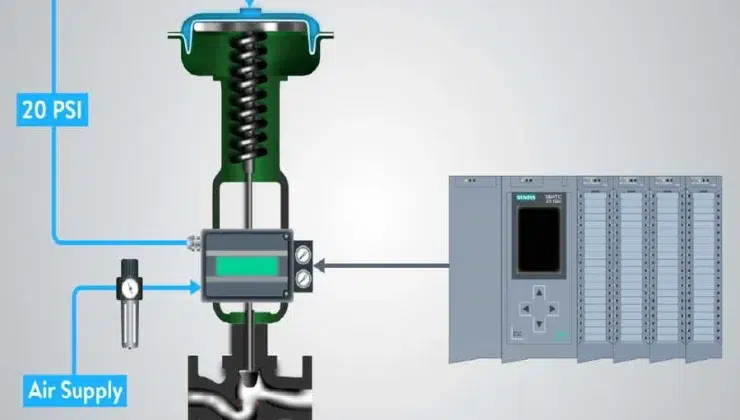
Inside the valve is a pneumatic actuator — typically a diaphragm or piston — that moves when compressed air is applied. This motion is transferred to the valve stem or plug, which then opens or closes the flow path. Once air pressure is removed, either a spring return mechanism or a second air line brings the valve back to its default position.
This makes air operated valves ideal for systems that require fast, repeatable, and remote-controlled actuation — especially where electrical components aren’t suitable due to explosion risks or washdown environments.
Where Are Pneumatic Valves Used?
I’ve personally worked with air operated valves in a wide range of industries, and they show up in places where durability, hygiene, or safety is critical. For example:
- Water and wastewater treatment — for automated dosing and flow switching
- Food and beverage plants — especially diaphragm valves in CIP (clean-in-place) lines
- Pharmaceutical manufacturing — sterile and non-contact flow control
- Chemical processing — high-cycle or hazardous media control
- Compressed air systems — isolating or venting lines
- Packaging machines — pneumatic valves operating at high speed with minimal electrical interference
If your system runs on compressed air, odds are it’s controlling a valve somewhere.
“Air Operated” vs “Pneumatically Actuated” — What’s the Difference?
These terms are often used interchangeably, but here’s the nuance:
- Air operated valve usually refers to the complete assembly: actuator + valve body, functioning as one unit.
- Pneumatically actuated valve emphasizes that the actuator itself is powered by compressed air, and can be paired with different valve types (e.g., ball, butterfly, diaphragm).
In everyday engineering conversations, both mean the same thing. But when ordering components, it’s helpful to clarify whether you’re sourcing just the actuator or the full valve package.
What Are the Main Components of a Pneumatic Valve?
Every air operated (pneumatic) valve may look like a simple block of metal from the outside, but inside, it’s a coordinated system of mechanical and pneumatic parts working together to control fluid flow. Whether I’m working with a basic on/off valve or a more complex control valve, the internal anatomy remains largely the same.
Here’s a breakdown of the key components that make up a typical pneumatic valve — and what each one does:
| Component | Function |
| Actuator | Converts air pressure into motion |
| Valve Body | Directs or blocks flow |
| Air Supply Port | Connects compressed air source |
| Stem / Plug | Moves to open or close flow path |
| Return Spring | Helps reset position after release |
How They Work Together:
- The actuator receives compressed air through the air supply port, generating mechanical force.
- This force drives the stem or plug, which shifts position to open or close the flow path inside the valve body.
- Once air pressure is released, the return spring (in single-acting configurations) pushes the stem back to its original position, closing the valve (or opening it — depending on the default state).
In many installations, these components are combined into a modular design, allowing quick replacement or service in the field — something I’ve come to appreciate when troubleshooting systems under tight downtime windows.
Some variations may include additional parts like solenoid pilots (for air piloting), position indicators, or even feedback sensors for closed-loop control. But at the core, these five elements are what keep the burkert valve operating as expected.
How Does an Air Operated Valve Open and Close?
At its core, an air operated valve uses compressed air to create mechanical movement — and that motion either opens or closes the flow path inside the valve body. I’ve seen this principle applied in everything from basic on/off water systems to high-precision chemical lines.
Let me walk you through exactly how it works — step by step.
Step-by-Step Operation
- Compressed air enters the actuator chamber
The system sends pressurized air into the upper or lower chamber of the actuator.
- Air pressure pushes a piston or diaphragm
The internal element (either a piston or flexible diaphragm) starts moving under the force of air pressure.
- Motion transfers to the stem or plug
This vertical or linear motion pushes or pulls the stem, which is mechanically connected to the internal valve element. - The valve opens or closes the flow path
Depending on the actuator type and airflow direction, the valve either allows media to pass or blocks it.
- Spring returns the valve to its original position (in single-acting designs)
When air pressure is removed, a built-in return spring resets the valve to its default “fail-safe” position — usually fully closed or fully open.
What Are the Types of Air Operated Valves?
Air operated valves come in a variety of forms, each designed to solve a different control problem — from basic start/stop functionality to high-pressure or hygienic applications. As someone who’s worked hands-on with valve installations in food plants, water treatment facilities, and steam systems, I can tell you: choosing the right valve type matters.
Below is a breakdown of the most common air operated valve types, their typical applications, and the actuation style they use:
| Type | Application | Actuation Style |
| On/Off Valve | Simple start/stop flow | Single-acting |
| Control Valve | Throttling flow | Double-acting |
| Diaphragm Valve | Hygienic systems (pharma/food) | Spring return |
| Angle Seat Valve | High-pressure steam/water | Pneumatic piston |
| Butterfly Valve | Large pipelines | Pneumatic rotary |
Short Notes on Each Valve Type:
- On/Off Valves
Ideal for applications where the flow needs to be either fully open or fully closed. These are widely used in packaging lines and utility systems where simplicity is key.
- Control Valves
Used for regulating flow — not just turning it on or off. These often require double-acting actuators to allow fine adjustments and precise feedback control.
- Diaphragm Valves
Common in food, beverage, and pharmaceutical environments. They’re hygienic by design and are often used with clean-in-place (CIP) systems. Their smooth internal surfaces reduce contamination risks.
- Angle Seat Valves
Great for high-pressure applications and aggressive media like steam. The seat design allows for quick closing with minimal water hammer.
- Butterfly Valves
Used in large-diameter pipes. The pneumatic rotary actuator turns the disc inside the pipe to control flow. These are excellent for space-saving and cost-effective flow isolation.
Pneumatic Valve vs Solenoid Valve: What’s the Difference?
If you’re building or maintaining an automated system, one common question you’ll run into is: should I use a pneumatic valve or a solenoid valve? I’ve had this discussion with engineers countless times — and the answer always depends on your application’s specific needs.
Let’s break it down side-by-side:
| Feature | Pneumatic Valve | Solenoid Valve |
| Power Source | Compressed air | Electrical current |
| Speed | Slower | Faster switching |
| Force Output | High | Low to moderate |
| Best Use | Industrial systems | Compact control panels |
| Maintenance | Medium | Low |
My Take as a Technician:
- Pneumatic valves shine in heavy-duty, high-cycle industrial systems, where compressed air is already available, and force output is a priority — like opening large valves or handling sticky media.
- Solenoid valves are better suited for compact or electronic control environments, where fast switching and plug-and-play operation are important — think coffee machines, medical devices, or basic irrigation setups.
One thing to remember: pneumatic valves can be more durable, especially in harsh conditions, but they require more infrastructure (air supply, tubing, regulators). Solenoids are easier to install, but they may not last as long in demanding environments.
When I spec out valves for new systems, I always look at cycle rate, available utilities (air or electricity), and fail-safe needs before making the call.
Are Air Operated Valves Used in Industry?
Air operated valves are found across a wide range of industries where fluid control needs to be fast, reliable, and hands-off. In my experience working on industrial automation projects, these valves are especially valuable in environments where electrical actuation is either unsafe or impractical.
In water and wastewater treatment systems, they’re used to control filtration, regulate inlet and outlet flows, and switch between processing tanks. Their resistance to humidity and electrical isolation makes them ideal in these setups.
In food and beverage production, especially in breweries, dairies, and bottling plants, air operated valves (often diaphragm-style) are used in filling lines and CIP (clean-in-place) systems. Their hygienic design and easy cleaning are major advantages.
Pharmaceutical manufacturers rely on pneumatic valves in sterile processing areas where electronic components may pose contamination risks. Spring-return air valves are often chosen here because they fail to a safe position during a power or air loss.
In chemical plants, these valves are used for dosing and transporting aggressive or hazardous media. Pneumatic actuators deliver the force needed to handle viscous or corrosive fluids while reducing ignition risk.
Finally, in pneumatic automation systems — such as packaging machines or robotic lines — air operated valves serve as key motion control components, controlling actuators, clamps, and conveyors. Since these systems already rely on compressed air, integrating pneumatic valves is both efficient and cost-effective.
How to Choose the Right Air Operated Valve
Choosing the right air operated valve isn’t just about matching pipe size or finding something in stock — it’s about engineering a reliable solution for your specific media, environment, and process. I’ve seen too many systems fail or underperform because someone skipped this step. Here’s how I approach valve selection, step by step.
1. Define the Media You’re Controlling
First, identify what will flow through the valve — air, water, steam, chemicals, viscous fluids, or gas. The type of media will influence everything else, from valve body material to seal selection.
- For example, steam requires high-temperature compatibility and pressure resistance.
- Chemicals may require PTFE-lined internals or full stainless-steel construction.
- Food or pharma fluids demand hygienic, clean-in-place (CIP) ready designs.
2. Choose the Right Actuation Type
Decide between single-acting and double-acting actuators:
- Single-acting valves use one air line and a spring to return to a safe (open or closed) position — great for safety-critical or fail-safe applications.
- Double-acting valves use air to open and close, offering tighter control and more consistent performance in high-cycle environments.
I usually recommend double-acting for control valves and high-speed systems, and single-acting for shutoff or emergency stop functions.
3. Confirm Operating Pressure and Temperature Ranges
Always check the maximum and minimum working pressure and temperature range of both your system and the valve. Underrated valves can deform, leak, or fail prematurely.
Don’t just look at the actuator — confirm these specs for the entire valve assembly, including seals and body materials.
4. Select the Right Valve Body Material
Common materials include:
- Stainless steel – corrosion-resistant, hygienic, durable
- Brass – cost-effective for general-purpose use
Plastic (PVC/PP) – chemical resistance, lightweight, but less durable under high pressure - Bronze or coated options – for marine or specialty use
If you’re working with harsh media or demanding environments, don’t cut corners on material choice.
5. Decide on Fail-Safe Behavior
Ask yourself: what should happen if air pressure is lost?
- Should the valve stay open, close, or hold its last position?
- For safety-critical systems, fail-closed is often required (e.g., gas lines, chemical dosing).
- In some systems (like tank venting), fail-open may be preferred.
This decision will guide whether you need a spring-return actuator, a lockout mechanism, or a manual override.
6. Consider Hygiene, Corrosion, and Certification Requirements
In industries like pharma, food, or medical, you may need:
- Sanitary or 3A-certified valve designs
- FDA- or USP-compliant materials
- Easy disassembly or SIP/CIP compatibility
How to Maintain an Air Operated Valve (Step-by-Step)
Regular maintenance is the key to keeping air operated valves running smoothly, especially in high-cycle or critical applications. I’ve seen valves last years with minimal issues — and I’ve seen them fail early due to neglect. The good news? Most maintenance can be done quickly and without special tools.
Here’s the process I follow in the field:
1. Shut Off the Air Supply and Depressurize the System
Before touching anything, isolate the valve by turning off the compressed air source. Then bleed any residual pressure from the actuator and connected lines. Never skip this step — trapped air can cause the actuator to move unexpectedly, which is dangerous.
2. Inspect the Actuator Chamber for Dust or Moisture
Remove the actuator cover (if applicable) and check the internal chamber. Look for dust, oil, or moisture, especially if the system doesn’t use filtered air. Contamination inside the actuator is a major cause of sticking or slow response.
3. Clean Internal Components and Check for Wear
Disassemble the actuator and valve body carefully. Clean any buildup on the stem, plug, diaphragm, or piston. Look for worn seals, cracked diaphragms, or scoring on moving parts. Replace anything that shows clear signs of fatigue.
4. Lubricate Seals and Moving Parts (If Required)
Use manufacturer-recommended lubricants — usually food-grade silicone grease or pneumatic-grade oil, depending on the application. Don’t overdo it; excess lubricant can attract dust or gum up tight spaces.
Note: Some modern valves come pre-lubricated and don’t require reapplication, so always check the spec sheet before adding anything.
5. Reassemble and Run a Test Cycle
Once cleaned and lubricated, reassemble the valve and reconnect the air supply. Cycle the valve a few times under normal operating pressure to make sure it opens, closes, and seals properly. Listen for air leaks and check for response lag.
Recommended Maintenance Frequency
- Light-duty / clean-air systems: Every 6–12 months
- High-cycle / harsh environments: Every 1–3 months
- Food/pharma systems: Clean and inspect during every sanitation cycle