Warning Sounds Your Furnace Should Never Make

Furnaces are a complex form of combustion equipment, and odd furnace noises cannot be ignored. The awareness of the meaning of these sounds and what sounds require immediate care attentiveness, can help you to preserve your home, comfort, and safety during the cold season.
By catching these signs early, you can rely on emergency heating repair when you truly need it, ensuring your system stays safe and efficient through the winter.
The Low Hum vs. The Red Flags
All furnaces produce some normal sounds. The low whine of the blower motor, the silent whoosh of air through ducts, or the low click when the thermostat turns the system on -all are the normal features of normal operation.
Red-flag furnace noises, on the other hand, are loud, abrupt, repetitive, or odd. They can be subtle in the beginning and develop gradually, or they can be sudden. Any kind of noise that interrupts the normal functioning or appears to be new will normally be an indicator of a problem with airflow, combustion, mechanical parts, or electrical parts.
Banging or Popping: Sudden Loud Impacts
One of the most terrifying types of noise and common furnace problems is a sudden bang or pop, and rightfully so. Although slight popping with some ductwork expansion is not a cause of concern, repeated bangs or loud bangs normally incur greater problems:
- Delayed ignition: Gas can be accumulated in the combustion chamber and burst out at once. This is a security issue of serious concern, because the delayed ignition may destroy the heat exchanger or cause harmful gas buildup.
- Metal swelling because of overheating: When your furnace overheats, the metal parts begin to swell very quickly with bangs or pops.
- Loose parts: Loose panels or a malfunctioning blower wheel will result in banging during the operation of the furnace.
Banging/ popping that is sustained should not be overlooked. These sounds tend to indicate defective burners, poor circulation of air, or defective ignition.
Whistling or High-Pitched Airy Sounds
Airflow problems are generally pointed to by whistling. Lack of free movement of air in the system causes it to move through small holes, which makes the air whistle high. Possible causes of common furnace problems include:
- Blocked air filters: This is one of the most prevalent causes of restriction of airflow.
- Damaged or leaking ductwork: Ducts may leak or have holes in the ductwork, which will lead to whistling.
- Blower problems: Overworking a blower could cause whistling.
Whistling through the air causes a strain on your furnace and uses more energy; hence, it is important to maintain the airflow to minimize the loss of the system.
Rattling, Vibrating, or Metal-on-Metal Noises
Rattling may be a symptom of any loose thing–yet the degree may be different:
- Loose screws, panels, or inner parts
- Cracked heat exchanger
- Unbalanced blower fan
This should be urgent with metal-on-metal sounds, particularly scraping or harsh vibrating.
Grinding, Scraping, or “Something is Stuck” Sounds
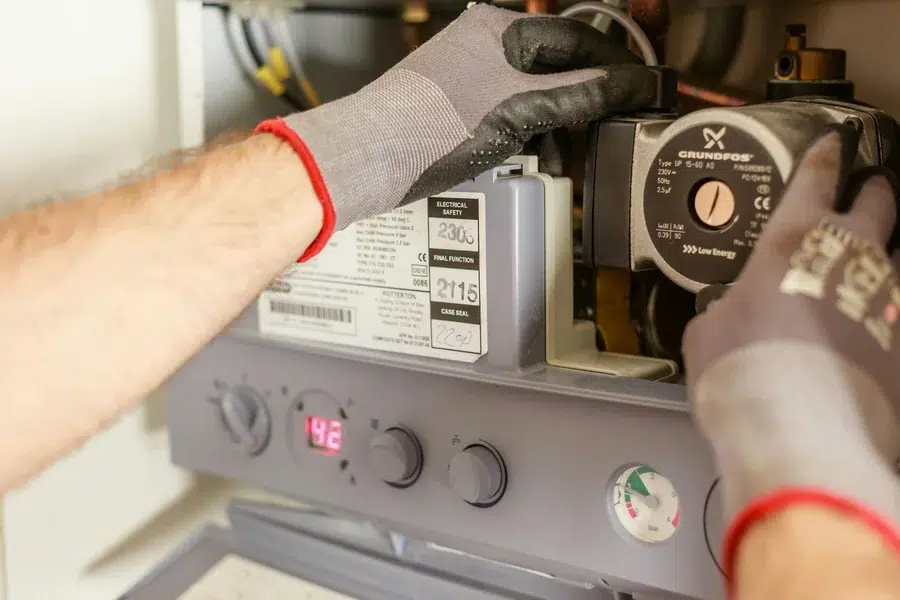
Such loud furnace sounds are especially worrying because noises like these are normally a sign of a mechanical failure. The most common ones among others are:
- Worn blower bearings: With time, the bearings will wear out, thus creating of grinding noise, which will only get worse with time.
- Displaced or broken blower wheel: Scraping- Scraping occurs as the wheel slides against the blower housing.
- Stuck debris in the system: A foreign object may be scraped or grated together when it touches a moving part.
The sound of grinding does not get better on its own. Further use may do a lot of harm; therefore, the furnace must be stopped and checked as soon as possible.
Clicking or Repeated Tapping
A normal reaction may be a single click when the furnace is activated; it is merely the ignition system at work. Nonetheless, constant clicking is a warning signal. Common causes include:
- Ineffective ignition system: In case the furnace is not capable of igniting, it will keep trying to do so and click many times.
- Electrical problems: Rapid clicking could be associated with faulty boards of the control, loose wiring, or breakdown of relays.
- Blocked or faulty gas valve: When the flow of gas is blocked, the system will insert itself multiple times in attempt to start.
A professional should always check whether the persistent clicking is leading to ignition failure or an unsafe background.
When to Call a Professional and What Not to Try Yourself
Homeowners are never supposed to make repairs on the ignition components, burner assemblies, blower motor, heat exchanger as well or internal wiring. Although the average cost of furnace repair is approximately $300, it could be more if you wait.
You are supposed to call a licensed HVAC specialist in case your furnace:
- Gives warning sounds that are loud or repetitive.
- Smells like gas or burning
- Fails to ignite properly
- Turns on and off repeatedly
- Shows signs of overheating
Firms such as Chill Heating and Cooling can deal with such issues before they become expensive or risky failures.
In Conclusion
The furnace is the most vital system in your house, especially during cold seasons. Where we have ordinary sounds, we have other sounds which are signs that something is amiss. Knowing how to notice these red flags when they first occur, call a professional as soon as possible, and you will be able to prevent breakdowns, be more efficient, and make your home a safer place.