5 Data Center Security Risks and Why Secure Colocation Is the Best Answer
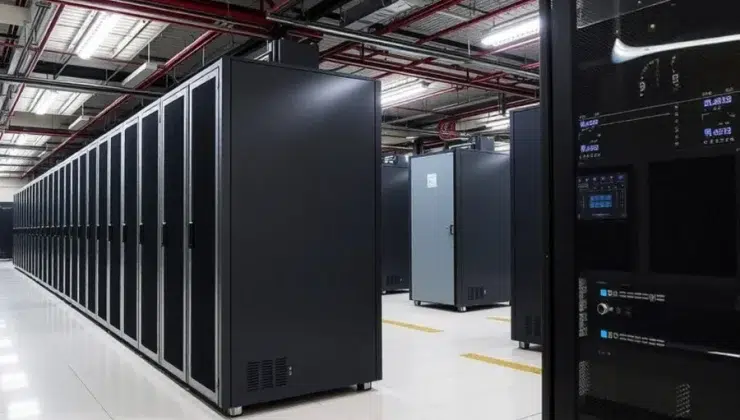
Power outages, cyberattacks, or unauthorized physical access—company server rooms face threats they are often not prepared for. Secure colocation delivers a multi-layered defense: redundant infrastructure, advanced 24/7 monitoring, and security features that in-house operations simply cannot replicate. Discover how a colocation facility is reshaping the paradigm of corporate data protection.
Underestimating security risks costs companies billions of dollars every year—not only in direct losses, but also in reputations shattered beyond repair. That is precisely why more and more organizations are turning to secure colocation as a solution capable of addressing all fronts at once.
1. Power Outages Are the Silent Killers of Operations
Electricity is the lifeblood of every data center. Just a few seconds without power and servers fall like dominoes, transactions disappear, and customer trust erodes. Most corporate server rooms rely on a single utility feed and a basic UPS that lasts only a few minutes, which is not enough.
Professional colocation facilities operate with redundant power architectures such as N+1 or 2N, meaning fully independent power paths. When the primary source fails, backup systems automatically take over the load without losing a single millisecond. Diesel generators keep operations running even during prolonged outages, while UPS systems bridge the transition so smoothly that servers do not even register the interruption. The difference becomes most apparent during a storm: an IT manager in a corporate server room anxiously watches alerts, while specialists in a colocation facility continue working calmly.
2. Cooling Failures—When Servers Literally Burn
Servers generate enormous amounts of heat, and without adequate cooling, they last only tens of minutes. Exceeding operating temperatures leads to performance throttling and often permanent component damage worth tens of thousands of dollars. Corporate server rooms typically rely on standard air conditioning, which has a critical weakness—when it fails, there is no backup.
Secure colocation addresses this risk with redundant cooling designed to ensure continuous heat removal. Modern colocation facilities deploy multiple cooling circuits with hot-aisle/cold-aisle configurations. If one circuit fails, the others automatically take over the load, and temperatures remain stable. Advanced facilities also monitor temperature in real time at the individual cabinet level and respond immediately to anomalies—while companies usually discover the problem only when servers are already collapsing.
3. Cyberattacks—the Enemy That Never Sleeps
Ransomware, DDoS attacks, and malware. Digital threats reached an average cost of $4.88 million per incident in 2024. Corporate server rooms often rely on a basic firewall and antivirus software, which is practically insufficient against sophisticated attacks. Attackers also never stop innovating—AI-powered phishing campaigns look so convincing that they can deceive even experienced administrators.
Secure colocation builds defense across multiple layers at once. Professional data center security includes:
- advanced firewalls,
- IDS/IPS systems for intrusion detection and prevention,
- encryption of data both in transit and at rest,
- continuous monitoring of network traffic.
Security specialists monitor the infrastructure 24/7 and can identify suspicious activity before it causes damage. Regular security audits and immediate patching of vulnerabilities ensure that security features remain up-to-date against the latest threats.
4. Unauthorized Physical Access—When an Attacker Does Not Need a Password
Software security is useless if an attacker can simply walk into the server room and unplug cables or steal hardware. Corporate server rooms typically rely on a door lock and maybe a camera, which does nothing to stop an attacker with a few seconds of access. Internal risks also come from employees, contractors, or cleaning staff who have access to critical areas.
A colocation facility implements multi-layered physical security based on the defense-in-depth principle:
- perimeter protection with fencing and surveillance cameras,
- controlled entry via reception with biometric authentication,
- segregated server rooms with additional authentication layers,
- individual rack locking.
Every entry is logged, every movement is monitored by cameras, and security personnel guard the site around the clock. Thorough vetting of employees and contractors helps eliminate insider threats before they turn into real problems.
5. Data Breaches and Inadequate Backups—Loss With No Way Back
Data loss represents an existential catastrophe. Whether caused by ransomware, hardware failure, or human error, companies without a robust backup system have little chance of recovery. In-house server rooms often back up data to the same location where production systems run, which means that in the event of fire or flooding, everything is lost at once.
Secure colocation typically includes managed backup services with automated backups, encryption, and regular recovery testing. In the event of an attack or disaster, companies can restore operations in hours rather than days. Compliance with regulations such as GDPR or ISO 27001 comes as an added benefit. Professional providers meet these standards as a matter of routine.
You Do Not Save on Security, But You Lose Money on Amateurism
Running your own server room may give a sense of control, but reality is often harsh—every dollar saved on security comes back as thousands lost during the first incident. Secure colocation delivers professional infrastructure built on redundancy, continuous monitoring, and security features tested across thousands of operational hours every day.
Sources:
- https://ttc-teleport.cz/en/
- https://www.datacenterknowledge.com/physical-security/5-physical-data-center-security-threats-that-are-easy-to-miss
- https://www.iso.org/standard/27001