Marketing Agency vs In-House Marketing for Construction Businesses
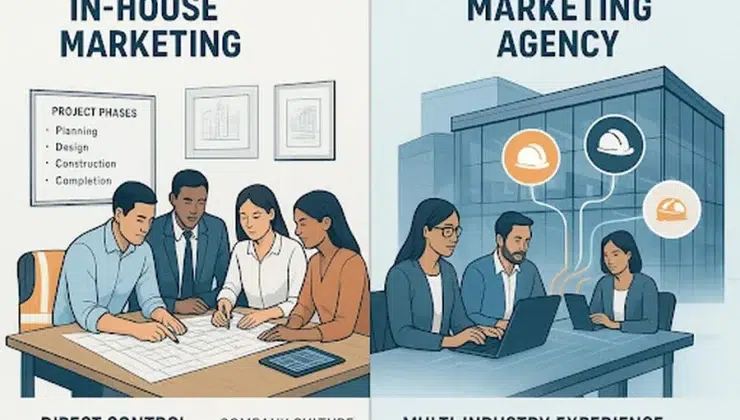
Construction companies that want to grow their visibility often ask whether to build their own marketing team or hire a marketing agency. There is no single right answer, as the best option depends on factors like company size, budget, goals, and how much control you want over your marketing.
An in-house team offers close brand understanding and direct oversight, while agencies provide wider skills, flexibility, and new ideas. Many companies actually find that a mix of both, combining internal staff with outside specialists, gives them a strong and flexible setup in today’s fast-moving market.
Handling digital marketing-from SEO and content to paid ads-takes a clear view of what you can do internally and what is better handled externally. For construction businesses that want a strong online presence, knowing how each model works is key. Whether you are a new company or long established, the right marketing setup can strongly affect growth, awareness, and profit.
Many modern construction firms are also gaining real benefits by working with a specialist marketing agency for the construction industry to handle these detailed marketing tasks.
What Is the Difference Between a Marketing Agency and In-House Marketing for Construction Businesses?
The main difference is who runs your marketing and where they sit in your business. In-house marketing means you employ your own marketing staff directly. They are on your payroll, part of your culture, and focused only on your brand. This team handles strategy, content, campaigns, and reporting, and often works closely with sales and operations so that everyone follows the same plan.
A marketing agency, on the other hand, is an outside company that serves many clients. Agencies can be full-service groups that do all kinds of marketing, or specialists that focus on one area like SEO, social media, or paid ads. They are independent but work closely with you to learn your goals and audience, then build and run marketing campaigns for your business.
Agencies bring a wide range of skills, tools, and processes, and can adjust the level of work up or down as needed.
How Does an In-House Marketing Team Work for Construction Companies?
An in-house marketing team operates as a built-in part of your construction company. You might have a marketing manager, a content writer, a social media person, and a designer all working only for your business (even if some are remote).
Because they are involved in your day-to-day work, they know your projects, language, and values very well. This close knowledge helps them create marketing that feels natural and closely matches your overall business plans.
Sitting close to other teams makes communication smooth and decisions quick. If a project changes, a new service goes live, or you need urgent updates, an in-house team can react fast and update campaigns on the spot. They work with sales to support lead generation and with project managers to promote new builds or finished jobs.
They also have direct access to internal data, so they can track detailed performance and make fast, informed changes to improve return on investment (ROI).
What Services Do Marketing Agencies Provide to Construction Businesses?
Marketing agencies can act as your full marketing department or as a specialist partner to help your existing team. They usually employ experts in several digital marketing areas. For a construction firm, this can include SEO specialists to help your site rank for terms like “commercial builder near me,” content marketers to produce case studies and project pages, social media managers to promote your work on LinkedIn and Instagram, and paid ad specialists to run targeted lead generation campaigns.
Agencies also often handle web design and development, email marketing, PR, and detailed analytics. Because they work across different industries and client types, they see many approaches and new trends. This outside view can help construction companies spot new chances or problems that internal teams might miss, bringing fresh ideas and new tactics for campaigns or launches.
Comparing Core Benefits: Agency vs In-House Marketing in the Construction Sector
When a construction company weighs its marketing options, the choice often comes down to comparing the strengths of each model. Both in-house teams and agencies bring clear benefits, and knowing these helps you decide what fits your goals and situation best.
Expertise and Specialized Skills
One big difference between in-house teams and agencies is the range of skills they can offer. An in-house team might know your brand very well but may find it hard to cover all areas of modern digital marketing. Building a full internal team that can handle technical SEO, PPC, content, graphic design, and web development is expensive and difficult. Each area needs focused knowledge, ongoing learning, and often specific tools.
Agencies exist to bring multiple experts together. When you hire an agency, you gain access to a group of specialists, not just one person. This may include SEO strategists, conversion-focused writers, designers, and paid media managers working together. They stay up to date on new trends, algorithm updates, and tools, so your construction business benefits from current methods and efficient work. Since they serve different clients, they can apply lessons from other projects to your situation.
BuiltFor Studio is one such agency, bringing a diverse team of specialists who work in unison to craft tailored marketing strategies for the construction industry, ensuring your business stays competitive and ahead of the curve.
Control and Brand Alignment
Control and brand fit are often seen as the main strengths of in-house marketing. Internal marketers share your culture, mission, and values, so they understand your brand voice deeply. This helps them build strategies and content that feel honest and stay consistent with your vision. Because they work in your business every day, they keep messaging on track and can adjust quickly based on feedback from leadership or the field.
Agencies work hard to match your brand, but they are still outsiders. They usually need some onboarding time to learn your culture and voice. Even though they work closely with you and seek approvals, they handle daily work on their own, which means you give up some direct control. Clear communication and a shared plan are key. Agencies that know construction well can close this gap more easily, but if full internal oversight is very important to you, this is an issue to weigh carefully.
Speed, Agility, and Communication
In-house teams are often faster at internal communication and reacting to changes. When everyone is under the same roof (or within the same systems), ideas can be shared informally, approvals can move quickly, and campaigns can be changed the same day. This helps with time-sensitive offers, project news, or quick responses to industry updates. Close contact between marketing, sales, and project teams keeps everyone aligned and reduces delays.
Agencies usually follow set processes and serve many clients, which can lead to slightly longer response times. Communication often goes through planned calls and emails. While this structure is organized, it can’t always match the speed of an in-house chat.
However, many agencies offset this with clear workflows and bigger teams, so they can add more people to a project when needed. For large or urgent campaigns, this extra capacity can sometimes move faster than a small, overloaded in-house team.
Access to Resources and Technology
Hiring a marketing agency often gives immediate access to advanced tools and platforms that might be too expensive for a single construction business. Agencies pay for premium analytics tools, content and design software, SEO suites, and ad management systems. These tools help them produce better work faster and gain deeper insights than a small internal setup might manage without heavy investment.
For an in-house team, buying and managing these tools means high upfront and ongoing costs, plus training time. While an internal team can slowly build its own toolset, agencies already have mature systems in place and often get early access to new features. This can be a big advantage, especially for small or mid-size construction firms with limited software budgets.
Scalability and Flexibility
The ability to ramp marketing up or down quickly is a strong point of agencies. Construction workloads can change due to seasons, new sites, or market shifts. Agencies are set up to handle this. They can expand their work for a big launch or reduce it during slow periods, without you needing to hire or let go of staff.
Scaling an in-house team is harder. Growing capacity often means hiring, which takes time and money. Cutting back can leave you with underused people and fixed salary costs. Because of this, agencies can be very appealing for construction companies that face changing demand and want flexibility without long-term staffing commitments.
Key Challenges Construction Companies Face with Marketing Agencies and In-House Teams
Both setup options have downsides too. Construction companies should be aware of the main problems each model can bring so they can plan ahead and reduce risk.
Potential for Misalignment and Communication Issues with Agencies
A common issue with outside agencies is the risk of brand mismatch and poor communication. Because agencies handle several clients, they may not always grasp the details of your culture, identity, or complex project needs. This can result in campaigns that look professional but do not fully speak to your audience or reflect your values.
Delays in communication can also occur. While agencies set clear channels and schedules, the physical and organizational distance means quick, unplanned chats are rare. Different time zones, work habits, or not seeing your day-to-day operations can lead to confusion about priorities. For construction, where project deadlines and site details matter a lot, keeping the agency closely aligned and responsive takes effort and consistent, proactive updates from your side.
Resource Constraints and Knowledge Gaps in In-House Teams
In-house teams often struggle with limited staff and skills. Marketing covers many areas: SEO, content, analytics, social media, web development, and more. A small or mid-size team usually cannot be strong in every one of these. Hiring specialists for all of them is expensive, which can leave gaps or overworked team members.
Keeping up with changing digital trends and tools means constant training, which costs both money and time. Without outside input, an internal team may also fall into the same patterns, with fewer new ideas over time. If a key person leaves, you may lose important know-how, and it can take months to replace and train someone new, slowing down your marketing work.
Adapting to Industry Changes and Innovations
Marketing changes quickly with new tech like AI and shifting customer behavior. Both models face challenges here. In-house teams need ongoing training and investment in tools to keep up. Without regular learning and upgrades, they can fall behind and miss chances to use new platforms or methods effectively-especially in construction, where leadership is often focused on projects more than marketing trends.
Agencies are usually better placed to adjust fast because their business depends on staying current. They see many use cases, test new tools, and invest in research. But they still need to adapt these general insights to your specific needs as a construction company. You must review their ideas and choose what actually fits your goals, services, and local market.
Cost Considerations: Calculating ROI for Agencies and In-House Marketing
Money plays a big role in choosing a marketing setup. While you want strong ROI, in-house and agency models involve different cost types and long-term impacts.
How Do the Cost Structures Differ?
In-house teams bring mostly fixed costs. You pay salaries, benefits, recruiting fees, training, office space, hardware, and software. These costs continue whether the workload is heavy or light. While hourly cost can look lower than agency rates, the full overhead can be high.
Agencies usually work on variable costs: retainers, project fees, or both. The price might look higher than one salary, but it covers access to a full team, tools, and systems, without paying for benefits or office space. Agencies can also be cheaper for short-term or highly skilled projects because you only pay when you use them.
Short-Term vs Long-Term Financial Impact
In the short term, building an in-house team can be expensive because of hiring, setup, and training. For smaller firms or those with uneven marketing needs, this can be hard to justify. Agencies can often start quickly with a steady monthly fee, so you can launch campaigns without building a whole department.
Over the long term, the picture can change. If your company needs ongoing, wide-ranging marketing, a well-run in-house team may become more cost-effective. Their growing knowledge of your brand and market can lead to faster, better work over time. Agency costs, on the other hand, can add up across many years, especially if you keep a large scope of work with them. The best approach is to compare your expected long-term marketing demand with these cost patterns.
Budget Planning for Construction Marketing Success
Careful budget planning is key no matter which model you choose. For in-house teams, you should factor in all direct and indirect costs, including possible staff turnover and ongoing training. List salaries, benefits, tools, training, and any outside help you may still use.
For agencies, planning means clearly setting what you need and how they bill. Ask for clear pricing and details on what is covered (deliverables, reporting, meeting time, etc.). You may also want a small extra budget for surprise needs or expanded campaigns. The goal is to link spending directly to outcomes like more leads, stronger visibility, and higher conversion rates on your projects.
Emerging Trends Impacting Construction Marketing Strategies
The construction sector is paying more attention to modern marketing tools and methods. Several new trends are reshaping how firms reach and engage clients, affecting both in-house and agency work.
AI and automation now support more personal and efficient campaigns. AI can help with content ideas, data analysis, and campaign optimization, freeing staff to focus on strategy. For in-house teams, AI tools can boost productivity and give clearer insight into client behavior. Agencies use AI for detailed targeting, better forecasting, and scaling services.
Data privacy rules like GDPR and CCPA are also changing how marketing data is collected and used. Construction firms must keep marketing transparent and handle data responsibly. Internal teams need to focus on security and compliance, while agencies should offer strong data protection and clear processes.
Omnichannel marketing-giving clients a consistent experience across your website, email, social media, and events-is another key trend. In-house teams can use their deep brand knowledge to coordinate messages, while agencies can help connect and manage these channels with the right tools.
Content marketing still plays a major role, especially helpful, educational content. Internal staff often do well here because they know customer issues and project details first-hand. Agencies can support with video, copy, design, and distribution. With marketing changing fast, agencies bring broad experience across clients, and internal teams need to build habits of constant learning to keep pace.
Hybrid Models: Blending In-House and Agency Expertise
Because each model has strengths and weaknesses, many construction companies now choose a hybrid approach. This combines the close brand understanding and control of an in-house team with the specialized skills and flexibility of agencies.
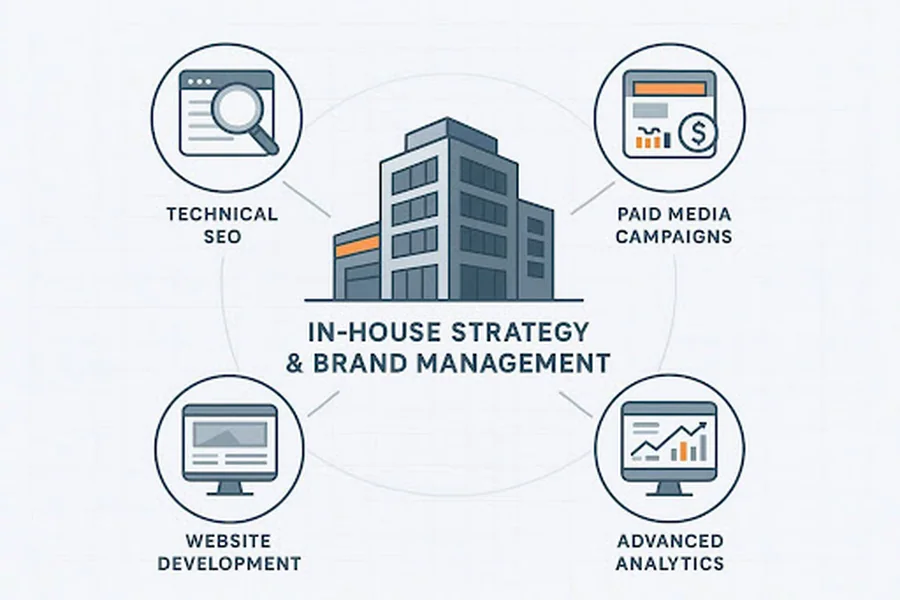
In a hybrid model, your internal team usually leads strategy, core content, and brand standards. They act as the central contact and keep messaging consistent. Highly technical or resource-heavy tasks-such as deep SEO audits, complex paid media, full website rebuilds, high-end design, or advanced analytics-are passed to agencies. This lets your internal staff stay focused on what they do best while still getting expert support where needed. For many construction firms, this mix offers both stability and the ability to grow quickly.
How to Choose: Decision Factors for Construction Businesses
Choosing between in-house and agency marketing is a major decision for a construction company. Instead of looking for a universal answer, you should match the model to your own situation, goals, and limits.
Assessing Marketing Needs and Business Objectives
Start by clearly stating your marketing needs and main business goals. Do you want more visibility in a local area? More qualified leads for certain types of projects? A better online reputation with a stronger portfolio? These goals decide the kind and level of marketing you require.
If your main focus is steady brand presence and long-term relationships built on storytelling, an in-house team might be better placed to handle that depth. If you want quick lead growth from targeted ads for a new development, an agency with strong paid media skills may serve you better.
Think about how broad your needs are. Do you want a full mix of channels (SEO, social, email, content, ads), or just certain campaigns? Broader, ongoing work can lean toward in-house for consistency, while narrow or technical projects fit agencies more naturally.
Evaluating Internal Capabilities and Talent
Before you bring in outside help, review your current team honestly. Do you already have staff doing some marketing tasks? Is there someone who knows your clients and market well but lacks formal marketing training? If you have a small but capable team, they might just need extra tools, training, or selected agency support instead of a full external takeover.
If your people are already overloaded, lack key skills (like SEO, analytics, or video), or cannot keep pace with digital changes, outside support becomes more attractive. Building a marketing team from scratch requires time, money, and management capacity. Look at what skills you have now and how much you can invest in developing your own talent over time.
Project Complexity and Required Skill Sets
The difficulty of your projects and the skills they call for are central to this choice. Complex needs-like CRM integrations, advanced technical SEO, or programmatic advertising-often require experienced specialists that agencies can provide. These topics may not need full-time in-house roles, making outsourcing more reasonable.
Projects that rely on detailed knowledge of your building process, client stories, or unique project features may be better handled internally. In-house staff can easily talk to project managers, visit sites, and collect real stories that outside teams might struggle to capture without a lot of background work. Decide whether your projects mainly need broad skills that internal teams can build, or rare, deep skills that are easier to buy in.
Cultural Fit and Brand Consistency
Your company culture and brand personality shape your marketing choice. In-house teams naturally share that culture and usually keep messaging consistent across all channels, from your website to bids and proposals.
With agencies, keeping the same tone and style takes more effort. You will need clear brand guidelines, shared expectations, and regular communication. Some agencies are very good at adapting to a client’s culture, but they may still miss subtler points. If your construction firm has a strong, distinct culture or long-standing brand values, you should check agency partners carefully to see if they can match that style.
Action Steps: Choosing the Most Effective Approach for Your Construction Business
Picking the right marketing setup goes beyond listing pros and cons. It requires a clear plan and realistic view of your timelines and resources. Here are practical steps you can follow.
Prioritize Marketing Goals and Timeline
Start by listing your main marketing goals and when you need to hit them. What must you achieve in the next 6, 12, and 24 months? Do you need a surge of leads for a new housing site soon, or are you focused on building a long-term reputation in sustainable building?
If you need fast, large-scale campaigns, an agency’s ability to scale quickly may be more useful. If you want long-term brand building and ongoing content, investing in an internal team can pay off over time.
Also think about urgency: if you need immediate help, an agency can usually start faster than you can recruit and train several internal hires. If you have more time and want to own the skills in-house, you can plan a slower build-up of your team.
Create a Roadmap for Talent or Partner Acquisition
Once your goals and timing are clear, draw up a roadmap for hiring staff or selecting partners.
- If you lean in-house: Define key roles (e.g., marketing manager, content creator, digital specialist), set a hiring schedule, and plan for salaries, benefits, and ongoing training. Decide which core tasks must stay internal to protect brand quality-such as content that depends heavily on project knowledge or client relationships.
- If you lean agency or hybrid: Plan a structured selection process. Look for agencies with strong experience in construction or similar B2B services. Prepare a clear brief or RFP outlining goals, budget, and expectations. Review each agency’s results, communication style, transparency, and reporting. For a hybrid approach, clarify which tasks stay in-house and which go to the agency, so there are no gaps or overlaps.
Frequently Asked Questions About Marketing Agency vs In-House Marketing for Construction Businesses
What Are Signs It’s Time to Outsource Marketing?
Certain signs suggest it may be time to bring in an agency. If your in-house team is always overloaded, lacks key skills like advanced SEO or paid ads, or can’t keep up with digital changes, an agency can help close those gaps. If your results have plateaued and your campaigns feel repetitive or ineffective, an outside viewpoint can refresh your strategy.
Another sign is when you need to scale marketing quickly for a project launch or growth phase but don’t have time or budget to hire more internal staff. Agencies can add capacity quickly. If your budget can’t stretch to a full internal team with many specialties, an agency can give you access to multiple experts for a single, predictable fee.
Should Small Construction Firms Build In-House or Hire an Agency?
Smaller firms often benefit from starting with an agency. Building an internal marketing department means high costs in salaries, tools, and training, which can be tough for limited budgets. It’s also harder for small firms to recruit and retain skilled specialists in all areas of marketing.
An agency, especially one that understands construction, can provide a wide range of skills and tools at a cost many small firms can handle. You can keep simple tasks like basic social media posts or client updates in-house, while the agency handles website work, SEO, and lead generation. As your company grows and your needs become more stable, you can shift to a hybrid model or gradually build an internal team.
How Can Companies Transition Between Models Without Disrupting Projects?
Moving from in-house to agency, or from agency to in-house, should be done with a clear plan to avoid disrupting campaigns.
When moving from in-house to an agency, hold detailed onboarding sessions. Share your brand guidelines, audience profiles, past results, ongoing projects, and goals. Give the agency access to your accounts, data, and creative assets. With proper handover, most agencies can take over smoothly.
If you are moving from an agency to an in-house team, arrange a full knowledge transfer. Ask the agency to share campaign reports, strategy documents, login details, and creative files. An overlap period-where your new team works side by side with the agency-can help your staff learn quickly while campaigns continue running. Clear roles, timelines, and communication plans during the switch help keep projects on track.