The Difference Between a Fixed and Variable Speed Compressor Might Seem Technical
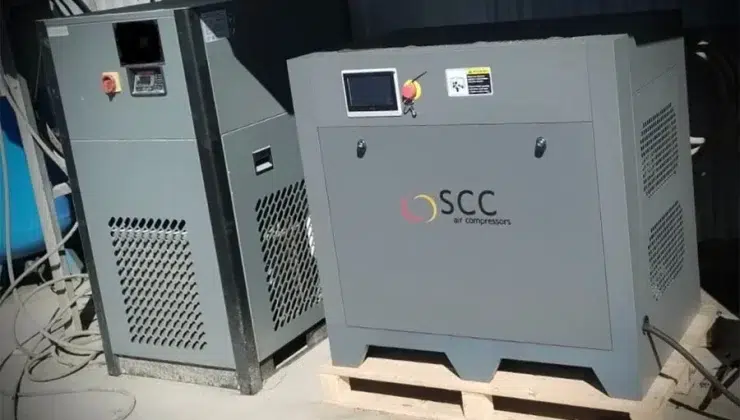
The question that most buyers approach backward is: which compressor is better, fixed speed or variable speed? The correct question is: which one matches how your facility actually uses compressed air? Neither technology is universally superior. They are built for different operating conditions, and putting the right machine against the right demand profile is where most of the efficiency either gets captured or gets lost.
Compressed air is not a passive utility. In most manufacturing and industrial facilities it is one of the largest electricity consumers on site, sometimes accounting for 20 to 30 percent of total power use. Every percentage point of efficiency improvement translates directly to operating cost. The compressor type you choose — and whether it reflects your actual air demand pattern — is where most of that efficiency opportunity lives.
This guide works through both technologies in practical terms: how they function, where each performs best, how to think about the cost implications over time, and what to ask before making a selection.
How a Fixed Speed Rotary Screw Compressor Operates
A fixed speed rotary screw compressor runs its drive motor at a constant RPM. When system pressure in the receiver reaches the upper set point, the machine unloads: the inlet closes, air production stops, but the motor keeps running. When pressure drops back to the lower set point, the machine reloads and production resumes. Output varies by cycling between these states; the motor itself never slows down.
Well-engineered compressors rotary screw in fixed speed configurations are mechanically proven, with lower upfront cost than variable speed alternatives, simpler control electronics, and a track record in continuous industrial service spanning decades. For applications where demand is steady — where the machine operates at or near full load for the majority of its running hours — fixed speed delivers excellent value and needs no further justification.
The structural inefficiency appears at partial load. An unloaded fixed speed compressor does not consume zero power — it typically draws 25 to 35 percent of full-load current to keep the motor and drivetrain turning. In any application where demand fluctuates significantly and the machine regularly cycles between loaded and unloaded states, that standby consumption represents a persistent, avoidable cost.
How a Variable Speed Drive Compressor Operates
A variable speed drive (VSD) compressor uses an electronic frequency inverter to continuously adjust motor speed to match current air demand. When demand falls, the motor slows down proportionally. When demand rises, it accelerates. The machine never idles unloaded — it produces exactly what is needed at the minimum power required to maintain system pressure.
A well-selected variable speed rotary screw air compressor produces its efficiency advantage across the middle range of the load curve — precisely where fixed speed machines are burning energy cycling through load/unload cycles. In applications with variable demand, the documented energy savings from VSD technology typically range from 35 to 50 percent compared to a fixed speed machine of equivalent capacity. For a facility spending $30,000 per year on electricity to run its compressed air system, that can represent $10,000 to $15,000 in annual savings.
The trade-offs are real: VSD machines carry a purchase price premium of roughly 20 to 40 percent over fixed speed equivalents, and the drive electronics introduce an additional component that requires attention over the machine’s operating life. For applications where demand is consistent and the machine runs near full load continuously, that premium may not return quickly enough to justify the investment.
Defining Your Air Demand Profile
The single most important piece of information in this decision is your facility’s demand profile — how much air you use, when you use it, and how much that usage varies across shifts, seasons, and production cycles. Without this data, any compressor selection is partly a guess.
The most rigorous way to gather this data is a pressure-flow survey: a data logger records system pressure and, ideally, flow over a period of one to two weeks. The resulting curve shows not just average demand but how much the demand varies and at what frequency. A profile that looks like a nearly flat line from 8 a.m. to 5 p.m. tells a very different story than one that swings by 40 percent multiple times per hour.
If a formal survey isn’t available, a practical approximation is to observe the compressor’s behavior over a typical shift. A machine that runs loaded most of the time and rarely unloads is operating under consistent demand — a good sign for fixed speed. A machine that cycles frequently between loaded and unloaded, or that regularly runs unloaded for extended periods, is being matched against variable demand in a way that a VSD would serve more efficiently.
The Energy Cost Equation Over Time
Electricity accounts for approximately 70 to 80 percent of the total lifetime cost of a rotary screw compressor. Purchase price, installation, and maintenance together represent the remaining 20 to 30 percent. This ratio shapes how the fixed versus VSD decision should be framed: the machine that is cheaper to buy is rarely the machine that is cheaper to own.
A simple approximation for estimating the annual electricity cost of a compressor: multiply the motor horsepower by 0.746 to convert to kilowatts, then multiply by annual operating hours, then multiply by the local cost per kilowatt-hour. A 50 hp compressor running 4,000 hours per year at $0.12/kWh costs approximately $17,860 per year in electricity at full load. A 35 percent VSD saving would recover roughly $6,250 annually — a meaningful return against the premium paid for the variable speed machine.
This calculation works as an estimate, not a precise projection. Actual savings depend on the specific demand profile, the efficiency curves of the machines being compared, local energy costs, and any utility incentive programs that may apply. Several utilities offer rebates for VSD compressor installations; checking with your electricity provider before purchase is worth the time.
Fixed Speed Applications: Where the Technology Still Leads
Fixed speed rotary screw compressors remain the right choice for a specific and common set of applications. Continuous production environments where air demand is steady and predictable — food and beverage processing, paper manufacturing, large-scale painting or coating operations — often present demand profiles that are essentially flat across a shift. For these facilities, the load/unload cycling of a fixed speed machine is minimal, and the energy penalty of unloaded operation barely registers.
Fixed speed also makes sense when budget constraints make the VSD premium difficult to justify and when the operating hours are low enough that the total electricity spend is modest regardless of efficiency. A compressor running 1,500 hours per year is a different economic case than one running 6,000.
Maintenance simplicity is an additional argument for fixed speed in some contexts. The drive electronics of a VSD machine are not complicated, but they are an additional system that requires monitoring and periodic attention. In environments where technical support resources are limited, the mechanical simplicity of a fixed speed machine can be a genuine operational advantage.
Variable Speed Applications: Where the Investment Returns Fastest
Variable speed drive technology returns its premium most quickly in facilities where demand is inherently variable: multi-product manufacturing plants that run different tools and machinery on different shifts, automotive service operations with intermittent high-demand tasks, woodworking and metalworking shops with cyclical use, and any facility with meaningful overnight or weekend air demand reduction.
Demand variability is also common in facilities that have grown over time and added equipment incrementally. The air demand pattern in a production floor that has been reconfigured several times tends to be more irregular than one designed from the ground up. VSD handles that irregularity without penalty.
Soft-start capability is a secondary VSD advantage that matters more than it might seem. Fixed speed compressors draw a high inrush current at start-up — sometimes five to seven times the running current — which creates both electrical demand charges and mechanical stress on the drivetrain. A VSD ramps up gradually, eliminating inrush current entirely. For facilities with multiple compressors or sensitive electrical infrastructure, this is not a negligible benefit.
Evaluating Compressor Suppliers
The machine itself is part of the decision; the supplier is the other part. Compressed air systems require ongoing support — maintenance, parts availability, application troubleshooting, and, for larger systems, engineering guidance on system design. A supplier with genuine application expertise will run a demand survey before recommending a machine type, not after. They will present the energy cost case clearly, including realistic estimates for both fixed and variable speed scenarios, and let the numbers guide the conversation.
Resources like pneutech illustrate what it looks like when a supplier’s product range covers both fixed and variable speed options clearly — a breadth that allows for honest comparison across machine types rather than steering toward whichever category the supplier happens to carry. The willingness to recommend the simpler, less expensive option when it’s the right one is a more reliable indicator of supplier quality than any claim made in a product brochure.
Service network and parts availability are worth checking explicitly. A compressor with excellent efficiency characteristics that sits waiting for parts during a critical production period has a very different effective value than its specifications suggest. Ask about typical parts lead times, the availability of loaner or rental machines during scheduled maintenance, and what the service response commitment looks like for emergency breakdowns.
Making the Final Decision
The fixed versus variable speed decision reduces to a few concrete data points: your demand profile (consistent or variable), your annual operating hours, your local electricity cost, the purchase price premium for VSD in the size range you need, and any available utility incentives. With those numbers in hand, the payback calculation for variable speed is straightforward — and the right answer usually becomes clear.
For most facilities with genuinely variable demand, the VSD payback period falls between two and four years. For facilities with consistent, high-load demand, fixed speed is often the more defensible economic choice. The minority of applications where the answer is ambiguous are exactly the cases where working with a supplier who can model both scenarios transparently is most valuable.
The machine that runs for 10 years at the right efficiency point, maintained on schedule and monitored for performance, is worth considerably more than the machine that was cheaper to buy and costs more every month to run. That long view, applied honestly to your specific demand profile, is what the fixed versus variable speed decision is actually about.