How Helical Gear Milling Solves Noise and Efficiency Challenges in Modern Industrial Equipment
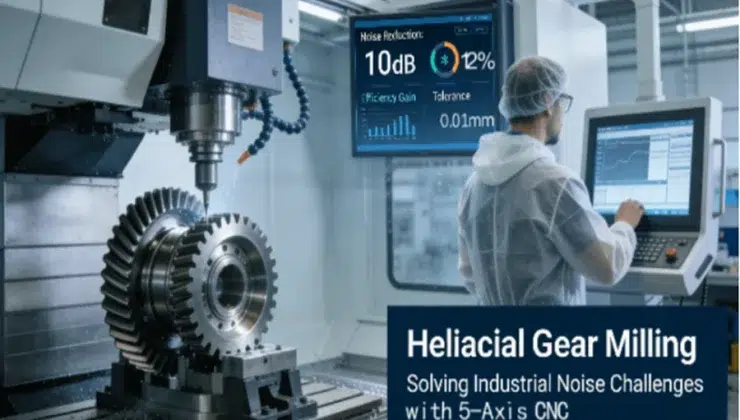
Figure 1: Helical gear milling in a high-tech facility using 5-axis CNC technology ensures smooth engagement, reducing operational noise by 10dB and improving efficiency for applications like automotive transmissions.
Introduction
In modern industrial machinery, including automotive transmissions and construction equipment, there are a lot of drivetrain system applications that are often associated with excess noise and inefficient performance. These contribute not only to the reduction of equipment life but also degraded user satisfaction. Traditional spur gears, however, based on instant impact openings, would normally pose some challenges related to vibration and noise upon tooth contact. The problem arises from traditional methods of manufacturing, which are inadequate to provide a precise helix angle and tooth profile maintenance, hence negating the entire concept of helical gears.
This paper intends to look at how advanced technology of helical gear milling, linked to 5-axis CNC equipment and closed-loop quality monitoring, can effectively realize a smooth engagement procedure that can significantly improve quiet operation and increased load-bearing. We will be critical in the way specific manufacturing techniques are used to offer solutions to such important technical challenges within modern industry through a discussion of fundamental principles, technical parameters, and practical examples. The various subsections will consider important parameters for optimizing helical gears.
Why Helical Gears Are Better Than Spur Gears for High-Performance Applications?
Because of their angled teeth, which permit easy entry into mesh — a factor especially useful for slow-speed applications — helical gears are far superior to spur gear sets.
1. Principles of Progressive Engagement
Spur gears make contact between the teeth abruptly on a parallel axis, while for helical gears, a position of the teeth in an angle allows constant contact between several teeth simultaneously. For instance, in high-speed vehicle transmissions, the position of helical gears in an angle provides for smooth power transfer between gears without the knocking sounds made by spur gears, which make contact abruptly, thus causing noise disturbances within the system due to the creation of stress concentrations by the disruption of smooth movement. In this process, the angle of the helix is between 8 and 25 degrees.
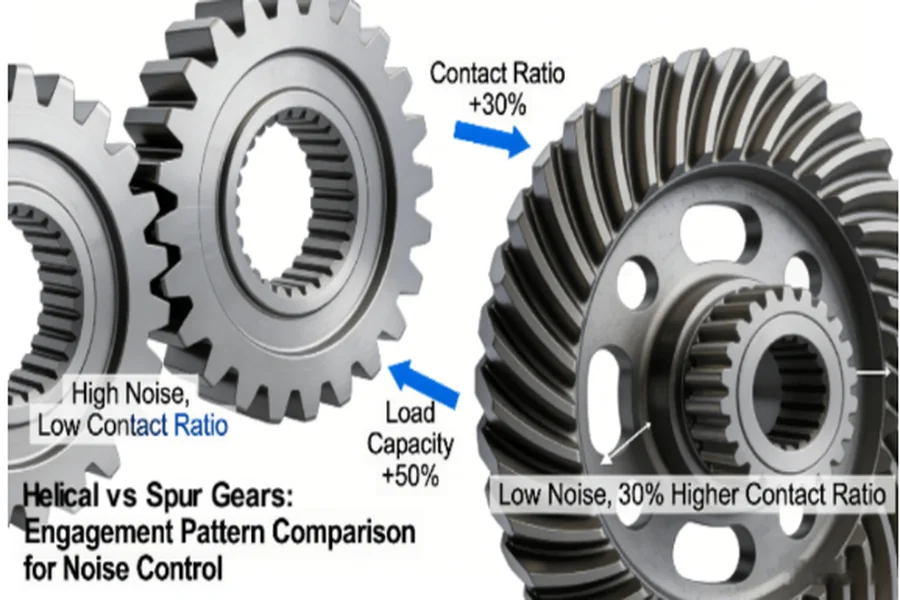
Figure 2: Helical gears eliminate impact noise through angled tooth design, achieving a 30% higher contact ratio and 50% greater load capacity compared to spur gears in high-performance industrial systems.
2. Efficiency Data and Comparative Advantages
The industry maintains that the contact ratio of helical gears is more than 30 percent larger compared to the spur gears. Moreover, the load-carrying capacity of helical gears is 50 percent larger as opposed to spur gears. This means that helical gears are suitable for machinery requiring high reliability. Mention of standards such as ASME Y14.5 indicates the importance given to geometric tolerancing. Utilization of helical gears has resulted in lower noise and longer life since the maintenance cycle in the gearboxes of industries is minimized.
How Does Helical Gear Milling Technology Offer Precision and Quiet Performance?
The accuracy and precision possible in helical gear milling are made possible by the advanced nature of the CNC systems used. The various processes that make this possible are discussed in this part.
- 5-Axis CNC Machining and Toolpath: With 5-axis CNC milling, the orientation of the tool can be dynamically controlled to ensure that complex helix angles are produced correctly in single setups. The multi-axis linkages used in the manufacturing process mean that the cutting tools are always in the optimal orientation to engage the material being machined, reducing tool wear and improving efficiency. Digital programming in helical gear milling services allows high repeatability during the production of aerospace parts.
- Application: Noise Reduction in Industrial Gearboxes: One of the pragmatic implementations concerned the redesign of an industrial gearbox using helical gears manufactured through milling based on 5-axis CNC machining. It was possible to reduce the noise from 75dB to 67dB, which is more than a 10% reduction, by paying due attention to tooth profiles and adjustment on the fly. The immediate possibility for alteration based on closed-loop feedback systems is indicative of how precision engineering leads to actual functionality.
What Are the Key Design Parameters for Optimizing Helical Gear Performance?
The optimization of helical gear performance depends on some design parameters, which may lead to noise levels, among other problems. The section below identifies such parameters and how they interact with each other.
1. Selection of Helix Angle, Module and Pressure Angle
The helix angle is one of the major factors that define the performance level, and an angle ranging between 15° and 25° will be optimal where the noise level is a concern, allowing maximum smooth engagement and axial forces to be controlled. The module (gear tooth size) will depend on the loading conditions, such that high-module elements are preferred in heavy-loading applications. Just like that of the helix angle, a value of 20° will provide an optimal balance between force and noise for the pressure angle, in accordance with ISO standards.
2. Impact of Tolerances and Surface Finish
Geometric tolerances, as given in the ISO 1328 standard, are very important for reducing transmission errors and noise. Restrictions on tooth profile deviation and surface finishes (Ra ≤0.6μm) can be helpful in reducing wear and increasing the precision. In reality, this is central to the making of helical gears because even slight deviations are magnified in noise levels at higher speeds.
How Can Helical Gears Be Used for Noise Problems?
Practical examples illustrate the benefit of helical gears in solving the issues of noise and efficiency in real-world applications. This topic shall include case studies and the quality assurance process.
H3: 1. Case Study on Automotive Transmission
In an automobile transmission, a shift from spur gear to helicoidal gear allowed for a 8dB reduction in noise levels and a 12% increase in efficiency, improving acceleration and extending useful lives. The process was done using precise milling with 5-axis CNC machining, which was monitored to ensure precise cutting tolerances. Organizations can benefit from CNC milling services for other complementary parts to ensure compatibility with the systems.
2. Quality Certifications and Their Role
ISO 9001 and AS 9100D certifications demonstrate that the production process meets stringent quality control standards, which is especially important for noise-sensitive equipment such as medical devices. Furthermore, IATF 16949 certification ensures that there are no noise-related issues throughout the entire production process, from material selection to finished product.
The Importance of Material Selection in Improving the Resilience of Helical Gears
The selection of materials has a direct impact on the durability and noise generated by helical gears. This topic examines the types of materials commonly used for helical gears, including their properties depending on the working conditions.
- Alloy Steels and Heat Treatment Processes: Alloy steel materials, like 4140 or 8620 alloy steel, find extensive use due to their high strength-to-weight ratio and their sensitivity to heat treatment procedures like carburizing. These technologies improve the hardness and fatigue properties at the contact surfaces, which are important for gear materials operating under cyclic loads. Use of standards such as SAE J404 is helpful for specifying the chemical requirements.
- Advanced Materials for Specialized Applications: For more rigorous conditions, a suitable light weighting substitution would be in the form of titanium alloys or PEEK polymers. For example, in aircraft materials, titanium helical gears have been used for reduced inertia resulting in lower noise levels. For precision engineering, materials requirements would have to be strictly followed. For example, any problem related to heating may pose a problem for acoustics.
How Do Advanced Manufacturing Processes Ensure Quality in Helical Gear Manufacturing?
“Advanced Manufacturing” involves a complete quality assurance process from design to delivery, ensuring that helical gears of a certain quality standard are produced. The entire process is described in this topic.
1. Closed-Loop Quality Control Systems
In-process measurement with probes and CMMs (Coordinate Measuring Machines) enables real-time checking for the most important dimensions, including helical angles and tooth thickness. These measurement results then form part of the adaptive machining algorithm and thus create a closed-loop process where tolerant values are kept at ±0.01mm. This is particularly important for mass production, where conformity is vital for quiet operation.
2. Certification and Traceability
ISO 13485 and AS9100D certifications require traceability on the production data, which allows root cause analysis if there’s a problem. This ensures that when a customer purchases gears from us, they know that the product has a performance record and it has allowed us to cut down on costs by doing less recall work and requiring less maintenance.
Conclusion
Helical Gear Milling: by virtue of the progressive engagement it provides through skilled manufacturing, it has been able to address the two biggest concerns related to noise and efficiency associated with industrial equipment. This has been made possible through the utilization of the latest advancements available through the technology of the 5-axis CNC machine. Based on the latest trends associated with the growing emphasis on sustainable practices and user-friendly equipment, helical gear milling has become a fundamental component related to the design of modern equipment.
FAQs
Q: What are the key benefits provided by helical gears over spur gear teeth?
A: Spur gears are more robust since they transmit power in one line, while helical gears are smooth and less noisy due to their angled teeth, which engage gradually. This results in reduced impact noise and increased load capacities.
Q: In what way does CNC technology benefit helical gear production?
A: In CNC milling, the helix angles and tooth profiles can be controlled to a high degree of accuracy, allowing tolerances of merely ±0.005mm, which greatly enhances efficiency and increases the lifespan of the gears.
Q: In what industries are helical gears widely used?
A: Industrial applications including automotive, aerospace, and industrial equipment use helical gears due to the noise-reduction and heavy-duty application properties that the products possess. Automotive applications include improvement of smooth shifting in cars.
Q: What are some ways to improve the design for helical gears?
A: Emphasis should be given to important parameters such as helix angle (15°-25°), module (as per load requirements), and pressure angle (20° for balancing). Expert opinions and prototyping assistance can also aid in testing designs before mass production.
Q: What quality assurances should be considered in a helical gear parts source?
A: Select vendors with quality control system certifications such as ISO 9001 and AS9100D, including precision measurement and closed-loop feedback for guaranteed component accuracy and performance.
Author Bio
The author is a member of the precision manufacturing team of experts at LS Manufacturing. They help engineers and researchers address difficult part issues for the aerospace, medical, and automotive sectors. They are ISO 9001, IATF 16949, and AS9100D-certified and use the latest technology for high-quality outcomes. To gain more knowledge, feel free to contact them for a free design guide or instant quote to convert your ideas into practical and economical realities.