That Small Puddle Outside Your Shower Door May Be More Important Than You Think
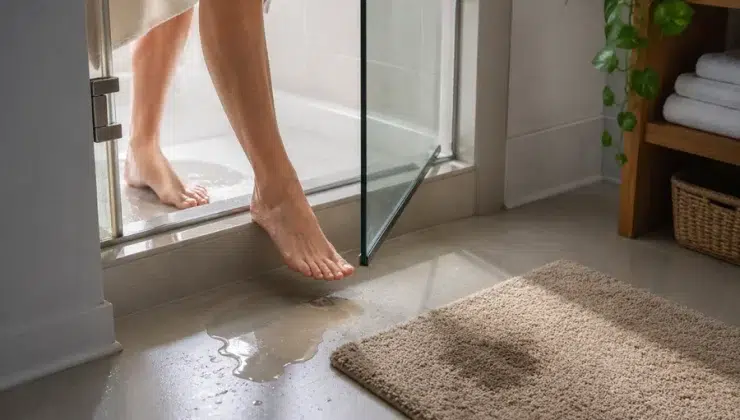
You know that moment when you step out of the shower and your foot lands on something wet?
Not soaking wet. Not “call someone immediately” wet. Just enough to make your sock damp and your morning slightly more annoying.
You wipe it up, blame the shower spray, and get on with your day. Then it happens again. The bath mat never quite dries. A faint water mark appears near the door. The grout starts looking a little darker than it used to.
It is easy to ignore because it feels small. But when the same puddle keeps appearing, your bathroom is usually trying to tell you something.
Why a Small Shower Leak Gets Overlooked
Small leaks rarely feel urgent. They do not stop the shower from working, and they do not look serious enough to justify a big repair.
So they become part of the routine.
You shower. You step out. You notice the water. You wipe the floor. You forget about it until tomorrow.
The trouble is that bathrooms already deal with enough moisture. A little water in the wrong place, day after day, can make the floor slippery, encourage mould around edges, and leave the room feeling harder to keep clean.
The puddle is not the whole problem. The repetition is.
When It Is Worth Checking the Shower Door Seals
Before assuming the whole shower enclosure needs attention, start with the small parts that control where water goes.
Look at the bottom of the door. Is there a visible gap?
Check the side. Does the seal still touch the glass properly?
Close the door and step outside. Can you see light through the join?
Run your fingers along the old seal. Is it stiff, cracked, yellowed, or loose?
These details are easy to miss, but water does not miss them. It will always find the easiest way out.
That is why the right replacement shower door seals can often solve a problem that feels bigger than it is. The important part is choosing a seal that matches the glass thickness, the gap size, the door design, and the place where the leak actually starts.
Specialist suppliers such as SIMBA usually organise shower door seals by those details rather than by length alone. That is useful because not every leak comes from the same place. Some start at the bottom of the door, some along the side, some around magnetic closing strips, and others near the frame.
Follow the Water, Not Your First Guess
Water is annoyingly honest. It does not take a complicated route. It goes wherever the easiest opening is.
Before buying a new part or calling it a bigger problem, dry the area around the shower door and run a quick test. Turn on the shower and check one section at a time.
Start at the bottom. If water runs out almost immediately, the bottom seal may be missing, worn, lifted, or not deep enough to cover the gap. Uneven gaps are especially common; one side can look fine while the other leaves just enough space for water to escape.
Then look at the side of the door. A vertical seal can stop working long before it looks completely damaged. Limescale, soap residue, or a slight bend in the strip can leave a narrow gap.
If you have a framed shower door and water appears between the wall and the frame, the seal at the bottom may not be the issue at all. Old silicone around the frame can crack or pull away from the wall, letting water creep through from behind.
A few minutes of watching where the water travels can save you from fixing the wrong thing.
Different Shower Doors Have Different Weak Spots
It is tempting to remove the old seal, take a quick photo, and buy the closest-looking replacement. Sometimes that works. Often, it does not.
Glass thickness matters. A loose seal may slide off; a tight one can be difficult to fit or stop the door moving smoothly.
The gap below the door matters as well. If the seal is too shallow, water still gets through. If it is too deep, it may drag along the floor and bend out of shape.
Door style changes the problem too. Sliding doors can leak around tracks or overlapping panels. Hinged doors often need attention at the bottom and side. Double doors may depend on the magnetic strip closing properly. Bath screens have their own trouble spot around the hinge, where water can travel near the pivot or fixing point unless that area is properly protected.
So before choosing a seal, it helps to know four things: the glass thickness, the gap size, the leak location, and the type of shower door.
Sometimes the Door Looks Closed, But Is Not Sealing
A shower door can look perfectly fine from a distance.
The glass lines up. The magnets touch. Nothing seems broken.
Then the shower spray hits the edge, and water slips through a gap you barely noticed.
Over time, magnetic strips can weaken. Hinges can drop slightly. A door that once closed neatly may start sitting a few millimetres out of place. That is enough to stop a seal from doing its job.
Next time, close the door and look from the outside. If there is light through the join, movement when you gently push the door, or a bottom edge that sits unevenly, the problem may be contact rather than the seal itself.
Leaks often build slowly. By the time you notice the puddle, the door may have been losing its fit for a while.
A Drier Bathroom Does Not Always Need a Big Fix
Real bathrooms are not showroom bathrooms. Floors slope a little. Gaps are not always even. Silicone ages. Frames shift slightly. Older shower doors rarely behave like they did on day one.
That does not always mean you need a major repair.
Sometimes the fix is simply understanding where the water is escaping and dealing with that small weak point. A better-fitting seal, a resealed frame, or a closer look at the hinge area can make the bathroom feel easier to live with.
So the next time you step out of the shower and find that familiar little puddle, do not dismiss it as “just one of those things.”
It may be a small sign that water has found a path it should not have. Deal with that path, and the bathroom becomes drier, easier to clean, and a lot less annoying after every shower.