How to Verify AI-Generated Information Before Using It
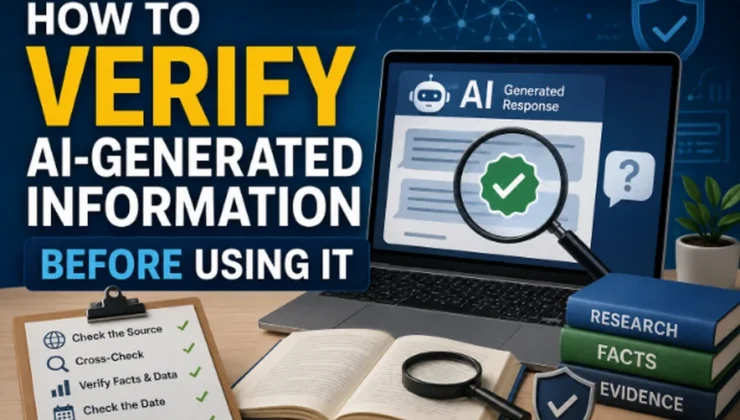
Artificial intelligence has changed the way people search for information, write content, conduct research, and solve everyday problems. AI tools can produce detailed answers within seconds, making them useful for students, marketers, business owners, researchers, writers, and professionals. However, fast and convincing answers are not necessarily accurate answers. AI systems can sometimes generate incorrect facts, outdated information, misleading explanations, or even references that do not exist.
This is why AI-generated information should be treated as a starting point rather than unquestioned evidence. Before publishing, sharing, citing, or making decisions based on AI output, it is important to verify the important claims independently. Platforms such as https://evostai.com/ reflect the growing role of artificial intelligence in the digital world, but responsible AI use still requires human judgment and careful verification.
Understand That AI Can Make Confident Mistakes
One of the biggest challenges with generative AI is that incorrect information can sound completely convincing. This problem is commonly described as an AI hallucination. An AI system may provide a specific date, statistic, person’s name, research paper, quotation, or historical event in a confident tone even when some of those details are inaccurate or unsupported.
Large language models are designed to generate coherent responses based on patterns in data. They are not automatically guaranteeing that every sentence they produce is factually correct. Research and official guidance on AI use therefore emphasize keeping humans involved and independently checking factual claims.
The writing style of an AI response should never be used as evidence of accuracy. A professional tone, detailed explanation, or highly specific statistic can still be wrong.
Identify the Claims That Need Verification
Before checking an entire AI-generated document, identify the statements that actually make factual claims. Dates, statistics, financial figures, names, quotations, research findings, laws, technical specifications, historical events, medical statements, and claims about organizations deserve particular attention.
For example, suppose an AI-generated article states that a particular industry grew by 42 percent during a specific year. Instead of assuming that the figure is correct, search for the original report containing that statistic. The same approach should be applied to claims such as company revenue, population numbers, survey results, market sizes, or scientific findings.
Separating factual claims from general explanations makes the verification process much more manageable.
Check the Original Source
When AI provides a source, citation, or reference, open the original material whenever possible. Simply seeing a source name is not enough. You need to determine whether the source exists and whether it actually supports the statement being made.
An AI tool might correctly identify a real organization but incorrectly attribute a statistic to it. It could also provide the correct title of a research paper while misrepresenting its findings. For academic references, check details such as the title, authors, publication date, journal, and DOI. After confirming that the publication exists, read the relevant section to determine whether it supports the claim.
Primary sources are particularly valuable. Government databases, official company announcements, original research papers, regulatory documents, court records, and recognized institutional reports generally provide stronger verification than websites that simply repeat information from elsewhere.
Cross-Check Information With Independent Sources
Important information should ideally be compared with more than one reliable source. Independent confirmation reduces the risk of relying on a single inaccurate article or incorrectly interpreted report.
Suppose AI gives you information about a major economic development. You could compare the claim with an official government publication, a recognized financial institution, and a reputable news organization. If these sources independently report similar information, you have much stronger evidence that the claim is reliable.
This method is especially useful for statistics and rapidly developing stories. When several websites repeat exactly the same unsupported statement, however, that does not necessarily make it true. Those websites may all be copying from the same original source.
Verify Dates and Look for Outdated Information
Information can be accurate and still be unsuitable because it is outdated. This is particularly important for technology, laws, software, prices, company policies, search engine guidelines, financial information, and current events.
Always check when the supporting information was published or last updated. If an AI response says that a particular rule is currently in effect, verify the rule through the relevant official authority. Similarly, current product specifications and software features should be checked against current documentation rather than an old article.
Pay particular attention to words such as “currently,” “latest,” “today,” and “recently.” These terms require current evidence.
Be Careful With AI-Generated Statistics and Quotations
Numbers can make an article appear authoritative, which makes fabricated or inaccurate statistics particularly dangerous. Whenever AI provides a percentage, survey result, market value, growth rate, or other precise figure, locate its original source.
Quotations deserve the same level of scrutiny. Confirm that the person actually made the statement and that the quotation has not been changed or taken out of context.
If you cannot find trustworthy evidence for a statistic or quotation, it is usually safer to remove it rather than present uncertain information as fact.
Examine the Quality of the Source
Not every website deserves equal trust. When verifying AI-generated information, consider who published the information, what evidence is provided, when it was published, and whether the publisher has relevant expertise.
Official institutions, peer-reviewed journals, recognized universities, established news organizations, and authoritative industry bodies can often provide stronger evidence than anonymous blogs or websites with unclear sourcing. This does not mean every established source is automatically correct. It means the credibility and evidence behind a source should form part of your evaluation.
The goal is not simply to find a webpage agreeing with the AI. The goal is to find reliable evidence supporting the claim.
Use AI to Assist Verification, Not Replace It
AI itself can help organize the verification process. You can ask an AI system to identify factual claims in a draft, highlight statements that require sources, or suggest what type of primary source could verify each statement. You can even compare responses from different AI systems.
However, asking another AI tool the same question is not equivalent to independent verification. Multiple systems may reproduce similar errors or rely on similar underlying information. Final verification should still involve trustworthy external evidence.
This distinction becomes especially important when using AI for professional research or content intended for publication.
Apply Extra Caution to High-Stakes Information
The amount of verification required should depend on how the information will be used. A minor mistake in an informal brainstorming session may have little impact, while an incorrect claim in legal, financial, medical, academic, or business material could have serious consequences.
High-stakes information should therefore receive additional scrutiny. Consult qualified professionals or authoritative sources when necessary instead of making significant decisions based only on an AI-generated response.
This principle also applies to content published under your own name or business. Once information is published, readers generally hold the publisher responsible for its accuracy, regardless of whether AI helped create it.
Develop a Habit of Responsible AI Use
AI is most useful when its speed is combined with human judgment. Instead of asking whether an AI answer looks believable, ask whether its important claims can be independently demonstrated.
Check factual statements, open original sources, compare independent evidence, verify dates, investigate statistics, and remove information that cannot be supported. A few additional minutes of verification can prevent inaccurate information from becoming part of an article, report, presentation, academic assignment, or business decision.
Final Thoughts
AI-generated information can save considerable time, but convenience should not replace verification. Artificial intelligence should be viewed as a powerful research and writing assistant rather than an unquestionable authority.
The safest approach is simple: identify important claims, locate trustworthy evidence, check original sources, confirm information independently, and apply greater scrutiny when the consequences of an error are serious. By combining AI tools with careful human verification, users can benefit from the speed of artificial intelligence while maintaining accuracy, credibility, and trust.