What Is IPR? How Your Orthodontist Makes Space for Straighter Teeth
If you’re getting clear aligners or braces, your treatment plan may include something called IPR. Hearing that a little enamel will be removed from your teeth can sound alarming. The good news: it’s a routine, carefully measured step, and most patients find it far easier than they expected.
Here’s what IPR is, how it feels, and what the research says about your teeth afterward.
What is IPR?
IPR stands for interproximal reduction. It means gently polishing away a very thin layer of enamel from the sides of teeth, where they touch their neighbors. You may also hear it called “stripping,” “slenderizing,” or “enamel reduction.”
Teeth need room to move into line. When they’re crowded, that room has to come from somewhere. IPR creates a small amount of space without pulling teeth, so your aligners or braces can guide everything into place.
IPR is also used to:
- Balance teeth that are slightly different sizes, so your bite fits together better
- Reshape contact points so teeth sit flush
- Reduce small “black triangles” in the gum line between front teeth
Your orthodontist plans exactly which teeth need IPR, and how much, before treatment begins. If you have clear aligners, this is built into your digital treatment plan.
How much enamel is removed?
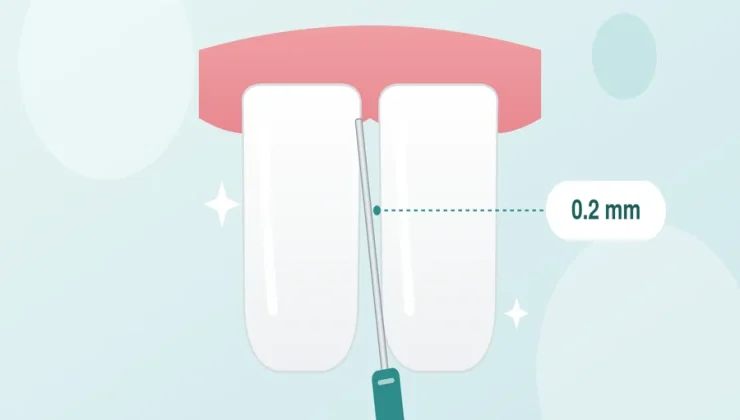
Very little. IPR is usually measured in tenths of a millimeter, often somewhere between 0.1 and 0.5 mm between two teeth. For comparison, a sheet of printer paper is about 0.1 mm thick.
That amount is split between the two neighboring teeth, and it stays well within the outer enamel layer. Your orthodontist checks the space with a thin measuring gauge as they go, so the amount removed matches the plan.
Because enamel doesn’t grow back, IPR is only done where the plan calls for it. That’s also why a careful assessment comes first.
Does IPR hurt?
For most people, no. Enamel has no nerves, so IPR doesn’t usually need any numbing. You’ll feel some vibration or pressure, and you may hear a slight grinding or scratching sound. Many patients compare it to a dental cleaning.
The appointment usually goes like this:
- Your orthodontist checks which teeth need IPR and how much.
- They polish the sides of those teeth using a fine bur, thin abrasive strips, or both.
- They measure the space with a gauge to confirm it matches the plan.
- They smooth and polish the surfaces so they’re easy to keep clean.
Afterward, some people notice mild sensitivity to cold for a few days. A sensitivity toothpaste usually helps. If sensitivity is strong or lasts longer than a week or two, let your orthodontist know.
Will I see gaps between my teeth?
You might, briefly. Right after IPR, you may notice tiny spaces where the teeth were polished. That’s the point: those spaces are the room your teeth need to move.
As your aligners or braces do their work, the teeth shift into those spaces and the gaps close. Food may catch there for a little while, so keep flossing as usual. If a gap is still there near the end of treatment, your orthodontist can close it with a refinement step.
Will IPR make my teeth more likely to get cavities?
The research so far is reassuring, as long as IPR is done carefully and the surfaces are polished afterward.
A 2023 study published in Cureus compared 90 orthodontic patients in three equal groups: IPR on the six lower front teeth, IPR plus a fluoride gel, and no IPR at all. Each tooth surface had about 0.1 mm of enamel removed. After treatment, the groups showed no meaningful difference in cavities, gum bleeding, or gum attachment. Adding fluoride gel didn’t change the results either.
That study was fairly small and looked only at lower front teeth in patients with braces. But its findings match longer-term research. A study that followed patients for more than 10 years after IPR on their lower front teeth also found those surfaces were no more prone to decay or gum disease than untreated ones.
The best protection is the same as always: brush twice a day with fluoride toothpaste, floss daily, and keep up with your regular dental checkups.
The tools behind a precise result
IPR instruments keep improving. One newer option is the ProxiBur system from Garrison Dental Solutions: a set of burs labeled by thickness, so the clinician can pick the exact reduction planned for each contact. It pairs with Garrison’s FitStrip abrasive strips for final smoothing.
Garrison says the system improves control and consistency, though independent studies comparing it with other IPR tools aren’t available yet. Whatever instrument is used, the things that matter most are a good plan, careful measurement, and a smooth finish.
Questions to ask at your consultation
- Which teeth need IPR, and how much space will it create?
- How will you measure the amount removed?
- Are there alternatives for my case, like expanding the arch?
- When in my treatment will IPR happen?
- What should I do if my teeth feel sensitive afterward?