
Is a 72V Electric Dirt Bike the Right Step Up
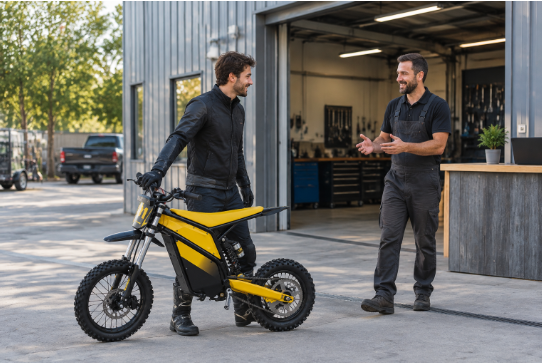
The tempting upgrade is easy to describe: more voltage, a more powerful-looking machine, and the promise of a bigger ride. The useful upgrade is harder to define. It solves something the current bike cannot do comfortably, without making the rest of ownership more difficult. Before moving to a higher-voltage electric dirt bike, name that missing capability. It might be a different chassis size, more suitable wheels, or a power delivery the rider can use on permitted terrain.
A rider who is comfortable on a smaller bike may be ready for a different machine, but familiarity with a throttle is not the same as being ready for every more capable model. Fit, experience, and the available riding area still govern the choice. The voltage label helps identify the electrical system; it does not replace those decisions.
What the bigger number actually tells you
A 72V electric dirt bike belongs to a higher-voltage system category, but that number is not a power rating. Motor output also depends on the battery’s delivery capability, controller settings, motor, and the way the system is designed. Two bikes carrying the same voltage label need not accelerate alike or sustain the same output.
Peak power deserves the same care. It describes a different condition from continuous output and should not be silently treated as power available throughout a ride. If the purpose of an upgrade is repeated work on a particular type of terrain, look for information about that use. A headline from a short burst cannot answer every question about a longer session.
Voltage is not battery energy either. Capacity expressed in watt-hours is more useful for comparing the listed energy of different packs than amp-hours alone. Even then, energy capacity is not a guaranteed riding distance. Terrain, speed, load, conditions, and riding style affect what a particular outing asks of the battery.
The chassis may change as much as the electrical system
An upgrade often means moving to a different complete bike, not receiving the same machine with one electrical number increased. Wheel sizes, seat dimensions, weight, suspension, and brakes may all change. Those differences affect the fit and handling a rider actually experiences. They should be part of the appeal, not details discovered after delivery.
The current V1 and V1 Pro illustrate this distinction. V1 is listed with a 52V 26Ah battery and 14-inch front/12-inch rear wheels. V1 Pro pairs a 72V 27Ah battery with 17-inch front/14-inch rear wheels. This is a comparison between two packages; any difference in their behavior cannot honestly be attributed to voltage alone.
Before judging the larger package, consider ordinary movements around it. Can the rider reach and operate the controls comfortably, support the bike as needed, and maneuver it without power? Where possible, assess the actual bike with suitable guidance. A size chart is a useful starting point, while the rider’s control and confidence determine whether the fit works in practice.
Put the desired improvement into a real ride
Replace “more performance” with a specific requirement. Perhaps the existing bike feels cramped, or its wheel layout is poorly matched to the permitted terrain used most often. Perhaps the rider wants a different handling character. Each is a more useful reason to evaluate a new model than simply wanting the largest number in the catalog.
Then consider whether there is a suitable place to use the new bike. More capability does not expand riding permission, and an empty patch of ground is not automatically an approved riding area. Check the rules and current conditions of the intended venue. A bike that exceeds what the rider or available space can accommodate is not a practical upgrade.
The range at heybike sports includes both V1 and V1 Pro, which makes the whole-bike comparison more informative than treating the names as successive voltage grades. Check the current model details for the version being ordered. The relevant question is which configuration fits the rider’s next stage, including the less exciting tasks of loading, storage, and routine care.
Allow for the parts of ownership that do not get faster
Transport equipment must suit the actual bike’s dimensions and weight. A carrier or storage arrangement that worked for one model cannot be presumed compatible with the next. Check load ratings, attachment requirements, and the loading movement before arranging a riding day around the new purchase. An awkward lift will still be awkward after the first enthusiastic weekend.
Keep the electrical equipment model-specific as well. A different voltage system is not a reason to experiment with chargers, replacement packs, or controller changes. Use the equipment specified for that bike and follow its instructions. An upgrade should arrive as a supported complete system, rather than become an improvised conversion project.
The decision becomes clearer when the rider can finish three sentences: the current bike limits this part of my riding; the proposed bike changes it in this way; and I can manage the new machine at the place I will use it. When those answers are concrete, a higher-voltage model may be a worthwhile step. When they are not, more seat time or a better-fitting setup may be the more useful next move.