How Aviator Became A Viral Phenomenon: The Game Everyone Suddenly Recognized
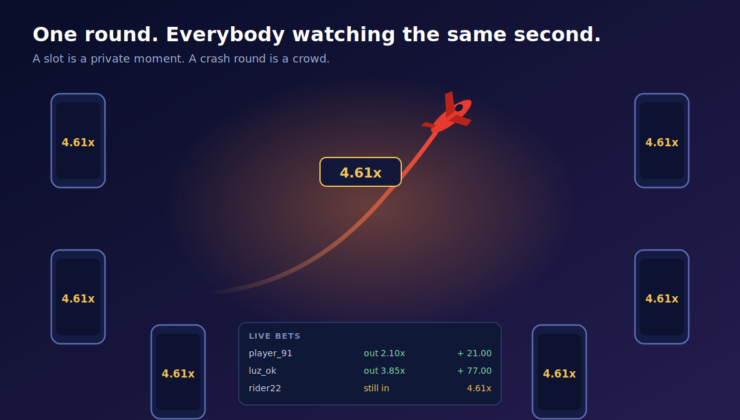
One plane, one number, and a round short enough to finish before you have explained the rules. That is the whole reason it traveled.
Some things spread because a marketing department willed them into existence. Others spread because they fit the shape of the internet so neatly that people do the work for free. Aviator belongs firmly in the second group. A red plane climbs across a dark screen, a multiplier ticks upward, and somewhere along the way the plane leaves and takes every bet still riding with it. That is the entire product. No characters, no lore, no tutorial. Yet within a few years the name went from a niche crash game to something millions of people recognize on sight, and the reasons say more about how the internet works than about gambling.
Everyone in a round watches the same plane at the same second, which is why the moment travels so well.
What Aviator is, and why the name is suddenly everywhere
The mechanics take one sentence. Spribe, an Estonian studio, launched Aviator in 2019, and it works like this: a plane takes off, a multiplier climbs from 1.00x, and you tap to bank your stake times whatever number is on screen before the plane disappears. A round lasts roughly five to thirty seconds. By 2024 the game had reached more than 2,000 online casinos across over 100 countries, which is an absurd spread for a title with no franchise behind it. The format itself was not new either. Crash games had existed since 2014 on Bitcoin sites. What changed was the packaging: a plane instead of a chart line, and a round anyone could understand instantly.
The shared round: how Aviator turned a solo bet into a spectator sport
Here is the part that made it contagious. Everyone in a round is in the same round, watching the same plane, at the same second. A live panel down the side shows what strangers staked and exactly where they bailed out, and a chat runs beside it. Slots never offered any of that: a slot is a private conversation between one person and one machine, and nobody screenshots a private conversation. A crash round is a crowd event. When someone rides to 50x, hundreds of people watch it happen in real time and know precisely what it was worth. When the plane vanishes at 1.01x, the whole room groans together. That shared timing is what turns a bet into a story worth retelling.
Built for a phone, and that is why it traveled
Look at where the game caught on hardest and the pattern is obvious: mobile-first countries across Latin America, India and Africa, where the phone is the only computer most people own. Aviator runs in a browser with no download, uses very little data, and starts at stakes small enough to be pocket change. Compare that with a slot that needs a heavy app, a long install and a lobby to navigate, and the difference is decisive. The game also ships with a free demo on virtual credits, so the barrier between hearing about it and trying it is a single tap. Nothing about that is accidental. Low friction is the whole distribution strategy.
Why the design spreads itself:
| Feature | Why it helps the game travel |
| A round of five to thirty seconds | Fits a bus ride, a queue, a coffee break |
| One shared round for everyone | Creates a crowd moment worth screenshotting |
| One decision, no rules to learn | Explains itself in a single sentence |
| Runs in a mobile browser | No download, little data, works on cheap phones |
| Free demo mode | Trying it costs nothing and needs no account |
The internet did Aviator’s marketing
Every viral thing needs raw material, and this game produces it constantly. A big multiplier is a perfect piece of content: one number, instantly legible, no context required. So the screenshots flow, then the clips, then the memes, then the reaction videos of people watching other people cash out. Streamers found it early because a five-second round is a natural rhythm for live content, with a hook and a payoff every few breaths. Then the parasites arrived, as they always do: “predictor” apps promising the crash point in advance, sold through slick clips that go viral precisely because the claim is outrageous. Those videos are edited after the round, and the tools cannot work, because the numbers that decide a round stay sealed until it ends.
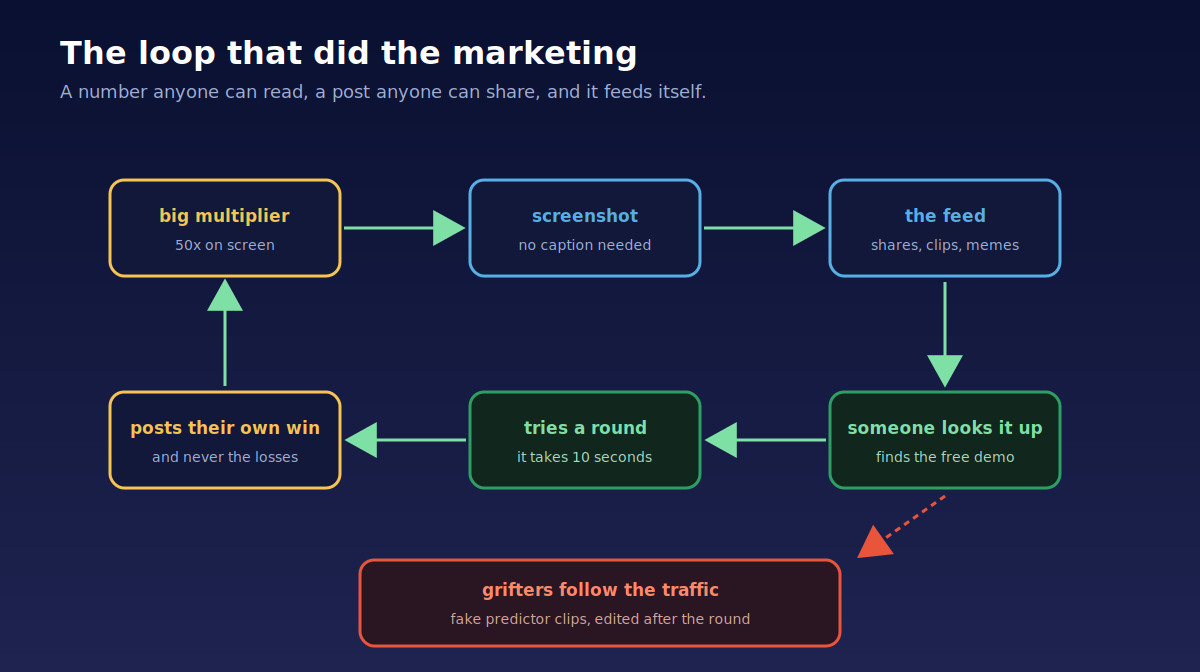
The loop runs on its own: a legible number, a screenshot, a new player, and a grifter selling shortcuts on the side.
The loop tends to run like this:
- A player hits a huge multiplier and screenshots the number.
- The post spreads, because the win explains itself with no caption needed.
- Curious viewers look up the game, find the free demo, and try a few rounds.
- Some of them post their own wins, and the cycle feeds itself.
- Grifters notice the traffic and sell fake predictors on the back of it.
What the Aviator hype leaves out
Every viral loop has a filter, and this one is unusually strong. Nobody screenshots the round where the plane left at 1.02x, and nobody makes a clip of an average Tuesday, so the feed shows a version of the game where big multipliers are common and losses barely exist. That is survivorship bias doing its usual work. The published math tells a plainer story: the game returns 97 percent to players over an enormous number of rounds, leaving a house edge of 3 percent, and some operators configure a lower figure, so it is worth checking the info panel. Rounds are independent, the history strip predicts nothing, and no clever exit rule moves the underlying numbers.
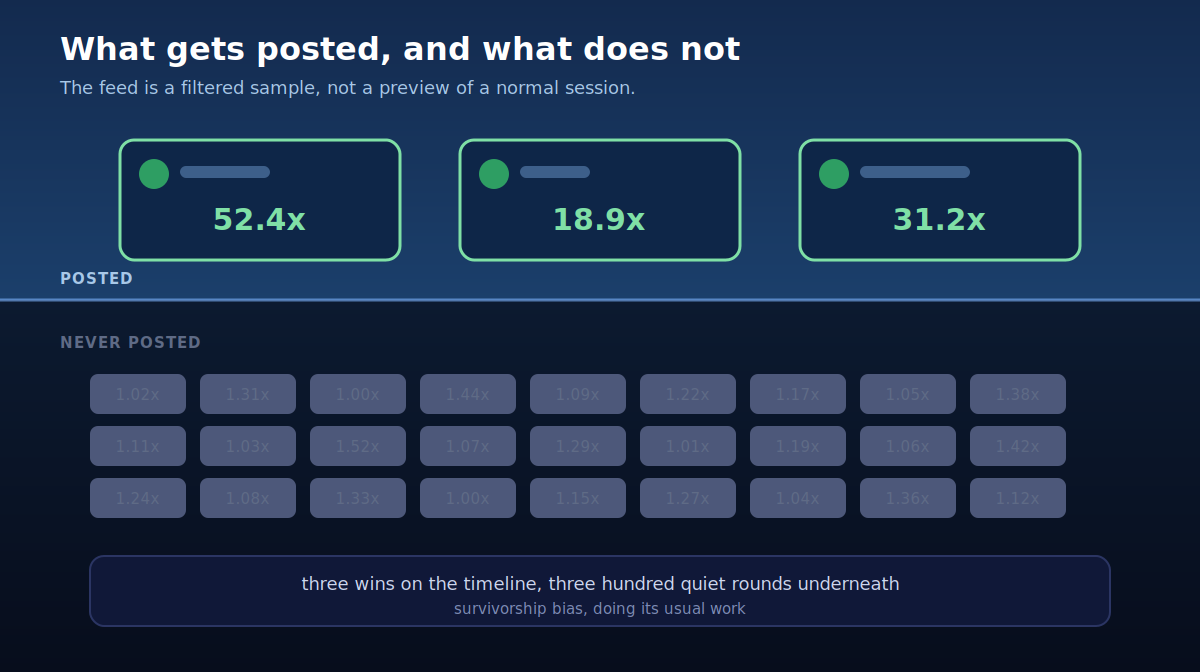
The feed shows the 50x. It never shows the three hundred rounds that quietly went nowhere.
What survives contact with the math:
- Big-win posts are a filtered sample, not a preview of a normal session.
- Predictors cannot work, because the round’s inputs stay hidden until it ends.
- RTP is a long-run average, not a promise about the next round or your afternoon.
- The demo behaves like the real game, minus the part where mistakes cost money.
None of this makes the phenomenon less interesting. A game with no story, no characters and no download reached a hundred countries in five years because it was shaped like a thing the internet already wanted: short, shared, legible at a glance, and easy to retell. That is a genuinely remarkable piece of design, and it deserves the attention it gets. It is also, underneath the plane and the noise, a casino game with a fixed edge, for adults only, on licensed platforms, and best treated as paid entertainment with a price you agree to before the first round rather than after a good one.