Beyond the Prompt: A Strategic Framework for AI-Driven Content Generation in 2026
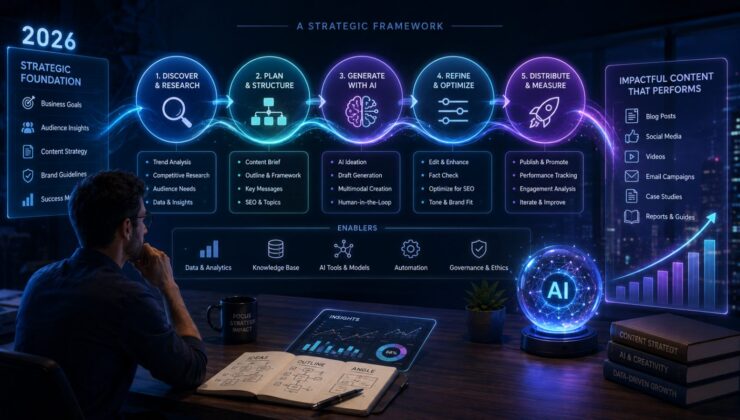
Effective AI-driven content generation in 2026 is not about writing better prompts. It is about building a strategy that combines source-of-truth content, brand voice controls, structured review processes, and multichannel distribution into a single system that produces content at scale without losing quality or consistency. The strategies that actually work share a common architecture: they treat AI as a component in a broader content operation, not as a replacement for one.
The past two years have flooded the market with tools that promise to generate content on demand. The early enthusiasm has since given way to a more sober assessment. Companies that plugged generative AI into their content operations without a strategy discovered that quantity does not compensate for quality, that generic AI output produces indistinguishable brand voice, and that the operational cost of reviewing bad AI content often exceeds the cost of producing good human content in the first place.
The companies producing meaningful business results from AI content generation share something specific: they built a strategy before they scaled the technology. This article outlines what that strategy looks like, the four pillars every serious program needs, and the mistakes that most consistently derail teams before they see results. At the technical core of every mature program sits an architecture of ai pipelines that connects drafting, review, translation, and publication into a continuous flow — an architecture Crowdin’s guide on mastering AI localization pipelines walks through in detail, using localization as the case study but with lessons that generalize directly to broader content strategy.
The failure mode is predictable. A team subscribes to a generative AI tool, writes a few prompts, and starts producing content. The output looks fine at first. But within weeks, the brand voice drifts, the same phrases appear across unrelated pieces, factual errors slip through, and the content team spends more time editing AI output than they used to spend writing from scratch. The tool becomes a liability rather than a leverage point.
Successful programs avoid this trap by treating AI as one component of a broader content system, not as a shortcut. The system includes source-of-truth content that grounds the AI in accurate information, brand voice controls that constrain how the AI writes, review processes that catch errors before publication, and distribution workflows that route content to the right channels in the right formats.
What separates the two approaches is discipline. Effective teams invest in the infrastructure around the AI before they scale the volume of content. Ineffective teams try to scale content volume first and discover the infrastructure gap only when the failures become visible.
The Four Pillars of an AI Content Strategy That Compounds
Every serious AI content generation strategy in 2026 rests on four operational pillars. Missing any one of them creates the failure modes that plague less mature programs.
1. Source-of-truth content that grounds the AI
The most consistent driver of AI content quality is the quality of the information the AI has access to. Retrieval-augmented generation (RAG), custom knowledge bases, and structured product documentation all serve the same purpose: they give the AI accurate, current material to work from instead of relying on its baseline training data. Teams that skip this step produce content that reads generically because the AI has nothing specific to reference.
The source-of-truth content should include:
- Current product documentation and feature descriptions
- Approved messaging frameworks and positioning statements
- Historical content that reflects the brand’s editorial voice
- Legal and compliance guardrails specific to the industry
- Regional context for multilingual operations
2. Brand voice controls that constrain output
Generic AI output produces generic content. Strong AI content strategies enforce voice through explicit controls: style guides encoded as prompts, glossaries that mandate specific terminology, tone parameters that shape sentence construction, and examples that anchor the AI on the brand’s actual writing rather than the average of the internet.
The best-performing programs treat brand voice as a technical specification, not a subjective preference. Voice profiles are versioned, tested against sample outputs, and updated as the brand evolves.
3. Structured review with human judgment where it matters
Every mature AI content program routes output through human review, but the smart ones do it selectively. High-stakes content — customer-facing marketing, legal disclosures, regulatory-sensitive material — goes to human editors. Routine content — internal knowledge base updates, first drafts of product descriptions, translation memory candidates — passes through automated quality checks and only reaches humans when the checks flag concerns.
The economics only work when review is calibrated. Reviewing everything produces bottlenecks that eliminate the throughput gains from AI. Reviewing nothing produces the quality collapse that destroys the program.
4. Distribution and localization as integrated stages
Content that is generated but not distributed produces no value. Effective strategies treat distribution as part of the generation workflow, with automated routing to the right channels, adaptation to the right formats, and localization for the right markets. The generation stage produces the raw material; the distribution stage turns it into business outcomes.
From Draft to Distribution: The Operational Workflow
The four pillars come together in an operational workflow that most successful AI content programs follow with only minor variation. A content brief enters the system, triggering the appropriate generation pipeline. The AI generates a draft grounded in source-of-truth content and constrained by brand voice controls. Automated quality checks scan the draft for factual issues, terminology inconsistencies, and voice deviations. Content that passes the checks with high confidence flows toward publication. Content that flags concerns routes to a human editor with the specific issues highlighted.
The connective tissue that turns individual AI capabilities into a coherent operation is a set of automated pipelines that route content through generation, review, translation, and publication as a continuous flow rather than isolated steps. The key insight from this architecture is that pipelines are model-agnostic: swapping the underlying AI engine should not require rebuilding the workflow. Teams that hard-code a specific model into their content system pay a rebuild cost every time the model landscape shifts, which in 2026 happens every few quarters.
Once approved, the content flows into distribution channels through automated routing. Marketing content goes to the CMS with appropriate metadata. Product documentation goes to the help center with the correct categorization. Multilingual variants flow through the localization pipeline and land in the right locale-specific versions. The entire cycle, from brief to published multilingual content, can compress from weeks to hours when the workflow is designed well.
The workflow also produces telemetry. Every stage generates logs and metrics that operators can use to diagnose bottlenecks, quality regressions, and cost overruns. Without this observability, AI content programs decay silently — problems accumulate for months before anyone notices.
Common Mistakes That Derail AI Content Programs
Even teams that understand the strategy in theory tend to stumble on a few recurring mistakes in execution.
The first is over-relying on a single AI model. Programs that hard-code a specific model become fragile when that model changes pricing, deprecates features, or degrades in quality. Mature programs abstract the model behind an interface that allows swapping engines without rebuilding the workflow.
The second is neglecting the human review layer. Teams that build sophisticated generation infrastructure often treat editorial review as an afterthought — rushed interfaces, no context, no feedback loops back into the AI. This produces bottlenecks that eliminate the throughput gains from automation and leaves editors demoralized about the entire program.
The third is failing to close the feedback loop. When editors correct AI output, those corrections should feed back into the system as training signal, glossary updates, or prompt refinements. Programs that treat every generation as isolated never improve. Programs that capture and apply feedback compound in quality over time.
The fourth is measuring the wrong outcomes. Throughput metrics look impressive but obscure the real question: did the content produce business value? Programs that measure only output volume tend to celebrate their way into a quality problem. Programs that measure engagement, conversion, and retention on AI-generated content develop a clear picture of what actually works.
How to Measure ROI on AI Content Programs
Measuring the return on an AI content program requires looking past the obvious metrics. Content volume, cost per piece, and time-to-publish are all easy to track but tell an incomplete story.
The metrics that actually indicate value include:
- Business outcomes per piece — conversions from marketing content, tickets deflected by help center articles, engagement on social content
- Editor throughput ratio — how much content a single editor can approve per week compared to the baseline
- Quality-adjusted cost — total cost per piece including AI inference, editing, and revision, weighted by the content’s business impact
- Time to first publication — how quickly a brief becomes published content across all target channels and locales
- Rework rate — percentage of AI-generated content that requires substantial editing versus light touch-ups
The most sophisticated programs also track content decay: how AI-generated content performs over time relative to human-generated content on the same topics. This reveals whether the AI is producing material that holds up in the real world or content that looks good on the day it ships but fails to deliver sustained value. MIT Technology Review has documented this pattern across multiple enterprise deployments, and their coverage remains one of the more balanced sources on how AI content programs mature over time.
Frequently Asked Questions
What is AI-driven content generation in practical terms?
AI-driven content generation is the use of large language models and related tools to produce written content — marketing copy, product documentation, support articles, translations, social media posts — at a scale that manual production cannot match. Effective programs combine AI generation with source-of-truth content, brand voice controls, human review, and automated distribution to maintain quality alongside volume.
Can AI fully replace human writers on an enterprise content team?
Not yet, and not for high-stakes content. AI can produce first drafts, handle routine content updates, generate variations of established formats, and dramatically accelerate localization. Human writers remain essential for original thinking, complex reporting, brand voice calibration, and content that carries legal or reputational risk. The dominant model in 2026 is AI-first drafting with human editing on flagged material.
What is the biggest mistake companies make with AI content generation?
Scaling volume before building the operational infrastructure around it. Programs that plug in generative AI without source-of-truth content, brand voice controls, review processes, and quality measurement produce output that looks fine initially but decays into generic material with factual drift and inconsistent tone. The infrastructure work must come first.
How much does an enterprise AI content generation program cost?
Costs vary widely by scope and volume. Small programs using off-the-shelf tools can run a few thousand dollars per month. Enterprise programs with custom models, integrated pipelines, dedicated editorial teams, and multilingual distribution can reach hundreds of thousands per year. The largest cost variable is typically human editorial time, followed by model inference on high-volume workloads.
What role does localization play in an AI content strategy?
Localization is where AI content generation compounds fastest. A well-designed program produces source content in one language and flows it through automated translation, human review, and locale-specific publication with minimal manual work. The compounding effect is dramatic: a piece of content produced once can reach ten or twenty markets on the same day, at a cost per market that keeps dropping as translation memory accumulates.
How do teams keep AI-generated content aligned with brand voice?
Through explicit voice controls: style guides encoded as prompts, glossaries that enforce terminology, curated examples that anchor the AI on the brand’s actual writing, and structured review processes that catch drift. Teams that treat voice as a technical specification rather than a subjective preference produce dramatically more consistent output than teams that rely on the AI’s default behavior.
How do I know if my AI content program is actually working?
Track business outcomes, not just output. Measure conversions, engagement, ticket deflection, retention, and other real-world signals from AI-generated content. Compare these signals against human-generated content on similar topics. Programs that produce measurable business impact are working. Programs that produce volume without impact are usually optimizing the wrong metric.
Conclusion
AI-driven content generation is a strategic capability, not a tool. The companies producing meaningful results in 2026 built the strategy first — the source-of-truth content, the voice controls, the review processes, the measurement framework — before scaling the technology. Those companies now operate content programs that would have been unthinkable three years ago: multilingual, multichannel, continuously produced, and consistent with brand voice across every touchpoint.
The teams that treat AI content generation as an operational discipline rather than a magic productivity trick are compounding advantages that will be difficult for competitors to match. The right strategy, wired into the right workflow, quietly becomes one of the most valuable content operations any modern company can own.