Gua Sha, Roller or Hands? What One Eight-Week Trial Measured
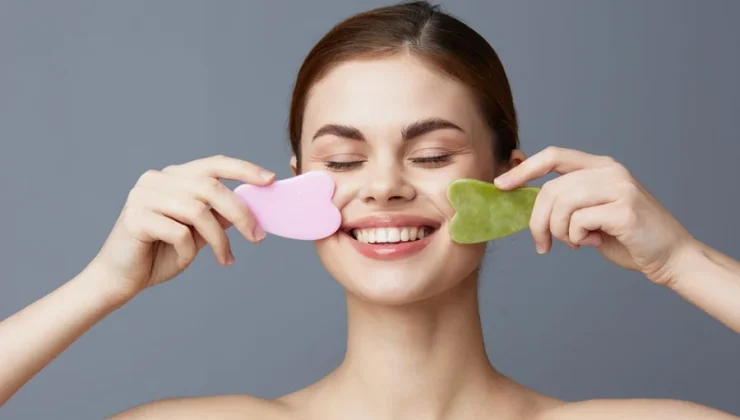
Facial massage tools come in many shapes, and each is described as doing something different. One randomized trial compared two of them directly, and a systematic review sets that trial in context.
The trial: roller versus gua sha
Dermatology Times reported on a randomized trial by Ahn and colleagues, published in the Journal of Cosmetic Dermatology in 2025. Thirty-four women aged 20 to 50 in Korea were split into two groups of 17. Each did 10-minute sessions five times a week for eight weeks while keeping their usual skincare routine.
That adds up to about 40 sessions and 400 minutes of massage per participant. Measurements came from 3D facial scanning, a Cutometer and a MyotonPRO.
| Tool | What changed, as reported |
| Gua sha | Reductions in oscillation frequency and dynamic stiffness, which are muscle tone measures |
| Facial roller | Gross elasticity up 8.6% and biological elasticity up 7.5% |
Only the gua sha group showed the muscle tone changes, and only the roller group showed the elasticity gains. The report itself calls for longer follow-up and more varied participants.
Why the tool and the target differ
The two results point to different tissue. Elasticity describes how the skin returns to shape after being pulled, and muscle tone describes the stiffness of the muscle beneath it. A session built around one tool may therefore aim at a different outcome than a session built around another, and a menu that lists tools gives a clue about the intended effect.
The wider evidence
A 2025 systematic review in Aesthetic Surgery Journal Open Forum examined conservative mechanical facial techniques. It included twelve studies covering 321 women aged 30 to 70, across facial exercises, myofunctional therapy and manual massage. Massage made up two or three of the twelve, depending on whether the abstract or the results section is read.
The authors reported improvements “confined to localized regions,” such as the cheeks, jawline and the area around the eyes. Five studies with 167 patients measured quality of life, and all reported improved self-perception and wellness. No adverse events were reported.
Their conclusion was cautious: current evidence “remains insufficient to establish the efficacy” of these techniques. They rated overall risk of bias as moderate. Many studies lacked control groups, only two used objective tools such as ultrasound or a Cutometer for the facial exercise outcomes, and most had no long-term follow-up.
Where hand-based traditions fit
Tokion describes Kobido as a traditional Japanese facial massage whose name means “the ancient road of beauty,” and says its history goes back 540 years. According to that article, practitioners vary their hand speed, sometimes tracing gently and sometimes applying strong acupressure. Neither the trial nor the review reports results for Kobido by name, so claims about it draw on tradition and practitioner accounts, with no trial data behind them here.
Reading a treatment description
A few checks help when a description promises a result:
- Does it say temporary or lasting? Both research sources report short-term, local findings.
- Does it name a body area? The review found changes in specific regions.
- Is the outcome an instrument reading or a self-report? Self-perception improved in the review, which differs from a scanner measurement.
- How long did the underlying study run? Eight weeks is the longest duration mentioned here.
Choosing a session
Anyone comparing facial massages at a studio can use these findings as a filter. Useful questions include which tools the session uses, what the therapist expects over one visit versus several, and how pressure is adjusted for different skin. A session described in terms of how skin looks or feels for a short time matches the evidence better than a promise of permanent change.
Skin conditions, recent procedures or sensitivities are worth mentioning before a session starts. The review recorded no adverse events, though the authors flagged the limits of that finding in small studies.
One visit in context
The trial’s schedule was 40 sessions over eight weeks. A single studio visit equals 1 of those 40, or 2.5% of the exposure that produced the reported changes. That figure explains why the sources describe findings in terms of repeated use. A one-off session fits best as a relaxing experience, and a studio can explain how it would space visits if a client wants a series.
The takeaway
Facial massage has early, modest and localized findings behind it, with quality-of-life improvements reported alongside. A visitor who treats a session as a short-term skin and relaxation experience, and who asks about tools and technique, is working from what the research can support.