Framed Fixed Glass Shower Panel: Pros, Cons & Uses
A fixed shower panel is one of the simplest ways to create a walk-in shower without adding a hinged or sliding door. Instead of opening and closing, the glass remains stationary and forms a barrier between the wet and dry areas of the bathroom. Adding a frame around the glass changes more than appearance, it can affect rigidity, sealing, hardware requirements, cleaning, and the overall visual character of the shower. In the U.S., framed fixed glass shower panels are available in several configurations, including full-frame designs, semi-framed arrangements, clear tempered glass, patterned glass, and finishes such as matte black, chrome, and brushed metal. Retail listings commonly pair fixed panels with tempered glass and bottom seals or other water-management components.
Understanding how these systems work is important before choosing one, particularly because a fixed panel is not automatically suitable for every shower layout.
What Is a Framed Fixed Glass Shower Panel?
A framed fixed glass shower panel is a stationary sheet of safety glass surrounded by a metal frame or framing system. Unlike a hinged shower door, it does not swing open. Unlike a sliding shower enclosure, it does not use rollers or tracks.
The frame typically provides structural support around some or all of the glass perimeter. Depending on the design, it may also incorporate seals, channels, brackets, or other components that help secure the panel and manage water.
Current U.S. retail products demonstrate that the category covers a fairly broad range of dimensions and configurations. Examples include fixed framed panels around 34 to 36 inches wide and approximately 72 to 78 inches high, with tempered glass thicknesses ranging from about 1/4 inch to 5/16 inch or more.
That variation matters. There is no universal panel size or configuration that works for every bathroom.
How Does a Fixed Shower Panel Work?
The basic concept is simple: the stationary panel creates a physical splash barrier while leaving an open entrance into the shower. The panel is normally anchored to a wall and, depending on its width and construction, may use additional framing or a stabilizing component. A bottom seal or water deflector can help reduce water escaping underneath or around the panel. Some framed designs use continuous perimeter framing, while others combine a frame with a support bar.
The goal is not necessarily to make the shower completely watertight. A fixed screen primarily controls spray and redirects water toward the shower area. Its effectiveness therefore depends heavily on the panel’s dimensions, location, showerhead position, floor slope, and overall bathroom layout.
This is an important distinction that homeowners sometimes overlook: a larger panel is not automatically better if it makes the shower difficult to enter or does not address the direction of water spray.
Why Choose a Framed Design?
Framing adds structure around the glass and creates a more visually defined shower screen. One of its practical advantages is rigidity. A continuous frame can help support the glass and provide a clearly defined mounting structure. Some framed designs also incorporate seals and water-control components directly into the frame.
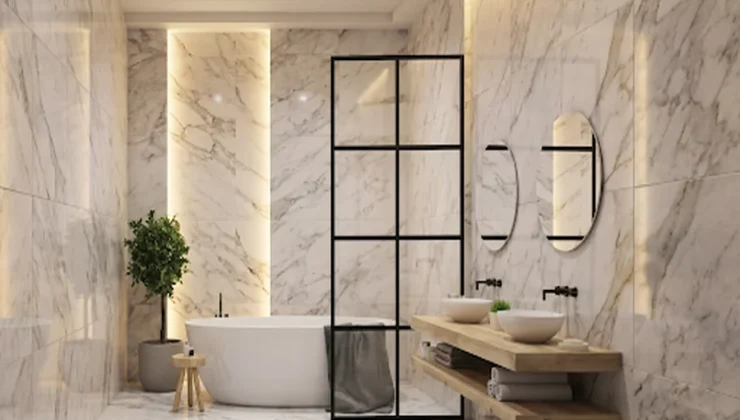
Framing can also make a strong design statement. Matte black frames, for example, are frequently used with contemporary and industrial-style bathrooms, while chrome and brushed finishes can work with more traditional or transitional interiors. U.S. retailers currently offer fixed framed shower designs in multiple metal finishes and glass configurations.
There is, however, a tradeoff. More framing means more visible metal and more surfaces where dust, soap residue, and mineral deposits can accumulate.
Framed vs. Frameless Fixed Shower Panels
The biggest visual difference is obvious: framed systems have substantially more visible metal around the glass, while frameless systems rely on discreet hardware, channels, or brackets. A frameless fixed panel can produce a cleaner architectural appearance because the glass becomes the dominant visual element. A framed panel creates stronger visual boundaries and can provide additional structural support.
Neither option is universally superior. For a minimalist bathroom with large-format tile and clean architectural lines, frameless glass may make more sense aesthetically. For a bathroom where black metal, industrial detailing, or stronger framing is already part of the design, a framed screen may integrate more naturally.
Cost should also be evaluated carefully rather than assuming one category is always cheaper. Glass thickness, dimensions, hardware, frame construction, finish, fabrication, and installation can all influence the final price.
What Glass Thickness Is Best?
Glass thickness is one of the most important technical specifications to evaluate. Fixed shower panels commonly use tempered safety glass. Current U.S. product listings show examples using 1/4-inch, 5/16-inch, and 3/8-inch glass, depending on the product and design.
Thicker glass generally provides a more substantial feel, but thickness should not be selected independently of the frame and mounting system.
A 3/8-inch panel with inappropriate support is not automatically safer than a properly engineered thinner panel. The complete assembly—including glass, frame, fasteners, wall structure, seals, and installation—needs to be appropriate for the application.
For residential shower applications, always verify that the selected glass meets applicable safety-glazing requirements and that the system is designed for shower use.
Why Tempered Glass Matters
Shower glass is typically safety glass because bathrooms are areas where accidental impact can occur. Tempered glass is heat-treated to increase its strength compared with ordinary annealed glass. When properly manufactured and processed, it is designed to break into smaller granular pieces rather than large, sharp shards when it fails.
The important point is that tempered glass cannot simply be cut or drilled after tempering. Dimensions, holes, notches, and other fabrication requirements need to be finalized before the glass undergoes the tempering process. That makes accurate measurements especially important for custom shower installations.
Does a Fixed Panel Keep Water Inside the Shower?
Yes, but only within limits. A stationary shower screen can significantly reduce splash reaching the bathroom floor, but it does not create the same enclosed barrier as a full shower enclosure with a door. Water containment depends on several factors. The showerhead should ideally direct water away from the opening. The panel needs adequate width and appropriate positioning. The shower floor must slope correctly toward the drain, and seals or deflectors need to be properly installed where required.
The relationship between panel size and shower layout is particularly important. A fixed screen that is too narrow may allow considerable spray to escape. A panel that is excessively wide can make entry uncomfortable or unnecessarily restrict the usable shower opening.
Where Are Fixed Framed Panels Most Useful?
Fixed framed panels are particularly suitable for walk-in shower layouts where a permanent splash barrier is sufficient. They can work well in larger bathrooms because there is often enough space to position the showerhead and panel strategically. They can also suit bathrooms where the homeowner wants a defined metal-and-glass aesthetic rather than the nearly invisible appearance associated with frameless glass.
Some products are also designed for bathtub applications, although the required dimensions and water-control considerations differ from a floor-level walk-in shower. Fixed screens can work effectively over a tub when properly sized and positioned.
Common Installation Mistakes to Avoid
Measuring From the Wrong Reference Point
One of the most expensive mistakes is measuring without accounting for the finished wall surface, tile thickness, floor slope, or actual mounting location.
Measurements should be taken from the finished installation surfaces rather than relying on rough framing dimensions.
Ignoring the Showerhead Location
A beautiful glass panel cannot compensate for poor shower planning. If the showerhead points directly toward the open side of the enclosure, water can escape regardless of how attractive the screen looks.
Choosing the Panel Width Based Only on Appearance
A wider panel provides more splash protection but reduces the entrance area. The ideal width is a compromise between water containment and comfortable access.
Treating the Frame as Purely Decorative
In a framed system, the frame can play a structural and sealing role. Its material, connections, wall attachment, and compatibility with the glass all matter.
How to Clean and Maintain a Framed Shower Screen
Glass itself is relatively straightforward to maintain, but the frame requires additional attention.
After showering, removing standing water from the glass can reduce the buildup of mineral deposits and soap residue. A suitable shower squeegee can help keep the surface cleaner between deeper cleanings.
Frame channels and seals should also be inspected periodically. Dirt and soap residue can collect in corners and along lower sections of the enclosure. Keeping drainage paths clear is particularly important.
Avoid aggressive abrasive cleaning methods that can damage metal finishes or scratch glass surfaces. Always follow the manufacturer’s cleaning recommendations for coated glass, seals, and frame finishes.
Is a Framed Fixed Panel Right for Your Bathroom?
The answer depends more on the shower layout than on design trends. A framed stationary panel makes sense when you want a permanent splash barrier, prefer visible framing, and have enough space to position the screen effectively. It can also be a practical choice when additional framing and defined mounting points are desirable.
A frameless panel may be more appropriate when the goal is a visually lighter installation with minimal visible hardware.
The mistake is treating this as a purely aesthetic decision. Shower glass is part of a functional system. Panel dimensions, glass type, frame design, mounting structure, water direction, seals, floor slope, and installation quality all influence the result.
Final Takeaway
The appeal of a framed fixed shower panel comes from its combination of stationary glass, defined framing, and relatively simple operation. It eliminates hinges and rollers while providing a permanent barrier between the shower and bathroom.
But the best installation is not necessarily the largest, thickest, or most heavily framed option. The correct choice depends on the shower’s dimensions, spray pattern, entry width, wall construction, glass specification, and design goals.
For homeowners comparing framed and frameless shower screens, the smartest approach is to evaluate the entire shower system rather than the glass panel alone. A well-designed fixed screen should balance water control, safety, accessibility, maintenance, structural support, and appearance.