How Agentic AI Is Redefining Software Testing
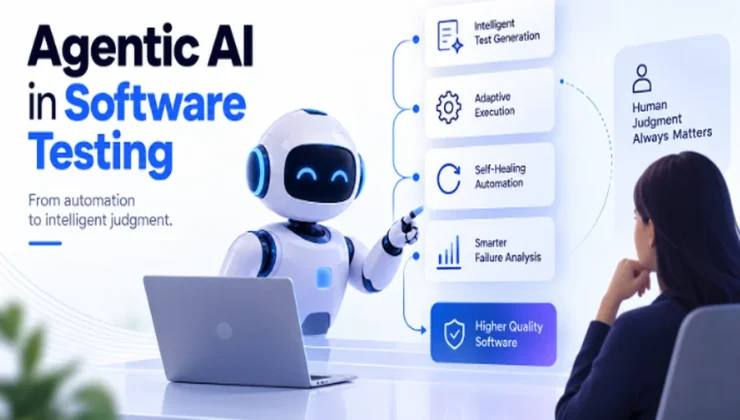
Software testing has spent decades automating execution. The huge shift is automating judgment.
Traditional automation waits for instructions like open this page, click this button, and validate this response. Agentic AI changes that model. Rather than only implementing a predefined script, an AI agent can interpret a testing goal, decide what actions to take, observe the outcome, adjust its approach, and continue until it has enough evidence to support a quality decision.
That is why agentic testing is becoming one of the most crucial shifts in modern quality engineering. The conversation is no longer only about how quickly teams can automate tests. It is about how intelligently they can decide what to test, where risk exists, and what to do when an application changes.
What Makes Agentic Testing Different
AI has already entered software testing through test generation, self-healing, test data creation, defect classification, and failure summaries. Most of these capabilities, however, are still reactive. So, humans begin the task, and AI finishes a narrow part of it.
Agentic Automation introduces an autonomous loop: understand the objective, plan an approach, select actions, execute tests, evaluate results, adapt when conditions change, and escalate decisions that require human judgment.
This moves testing from “run these steps” toward “achieve this quality objective.”
For example, instead of asking a tool to execute 200 regression tests, a team could give an agent the goal of validating whether a new checkout release is safe. The agent could identify affected workflows, prioritize high-risk paths, select or generate relevant tests, execute them, investigate failures, and summarize what needs attention.
From Test Scripts to Testing Intent
Traditional automation is built around scripts. They are explicit and predictable, but they can also become expensive to maintain as applications evolve.
Agentic systems can increasingly work from intent. A tester might define an outcome such as: “Verify that a returning customer can complete a purchase using a saved payment method after this release.”
The agent determines how to validate that intent. If the interface changes, the business goal remains the same even when the navigation path does not.
This does not make reusable test assets irrelevant. Instead, those assets become part of a broader reasoning system that combines business intent, application context, risk, and existing automation.
Autonomous Application Discovery
Before teams can test an application well, they need to understand it. Agentic AI can assist by exploring interfaces, recognizing workflows, identifying dependencies, and building a model of how users move through a system.
For enterprise applications, this can be especially valuable. Business processes often cross APIs, mobile apps, packaged applications, third-party services, and web interfaces. An agent that understands these relationships can support broader end-to-end test coverage instead of treating all channels as a separate testing problem.
Smarter Test Generation and Prioritization
Generating more tests is not necessarily progress. The more important question is whether teams are testing the scenarios most likely to expose business risk.
Agentic AI can use application changes, requirements, historical defects, workflow dependencies, and previous execution results to help determine what deserves attention first.
That makes regression testing more selective. Instead of running each test after every change, teams can prioritize areas with high potential impact while reserving full-suite execution for appropriate checkpoints.
The benefit is not just speed. It is closer alignment between testing effort and release risk.
Self-Healing Becomes More Context-Aware
Self-healing automation already helps teams recover when UI elements change. Agentic systems can extend that concept beyond individual locators.
If a workflow changes, an agent can evaluate what changed, determine whether the original business intent still holds, adapt the path, and assess whether the difference is an expected product change or a possible defect.
That distinction matters. Blindly repairing automation can hide genuine regressions. Effective agentic testing needs context and governance, not simply automatic correction.
Failure Analysis Moves Closer to the Test Run
Executing tests is often faster than understanding why they failed. A failure might come from a product defect, unstable environment, data issue, API dependency, interface change, or the automation itself.
Agentic AI can analyze execution history, logs, screenshots, application behavior, and related failures to suggest likely root causes while the run is still fresh.
Instead of presenting teams with a long list of failures, the system can help answer a more useful question:
“What changed, and what should we investigate first?”
The Human Role Becomes More Important
Autonomous testing does not remove testers. It changes where their expertise matters.
AI agents can explore, generate, execute, compare, and analyze at a scale humans cannot match. But quality is not purely a technical calculation.
Humans still define acceptable risk. They understand customer impact, regulatory obligations, unusual business conditions, and the difference between something that technically works and that should be released.
The strongest model is therefore human-in-the-loop. Agents handle repetitive execution and analysis. Testers define intent, review important decisions, challenge assumptions, and govern the boundaries within which agents operate.
What QA Teams Should Prepare for Next
Adopting agentic testing will require more than adding another AI tool. Teams will need clearly defined business flows, reliable environments, trustworthy test data, appropriate access controls, and governance over what agents can do. They will also need better measures of success.
This shift is accelerating with agentic automation in testing, where AI systems move beyond simple script execution to understand context, adapt to application changes, and determine the next best testing action.
Counting test cases will become less meaningful. Metrics such as risk coverage, escaped defects, time to diagnosis, maintenance effort, and release confidence will matter more.
It is clear that software testing is moving from automation that follows instructions toward systems that can pursue quality goals.
The opportunity is not to remove humans from testing. It is to give them autonomous capability for exploration, execution, adaptation, and analysis so they can focus on decisions where judgment matters most.
The next generation of testing will not be defined by who automates the most. It will be defined by who combines autonomous capability with human judgment most effectively.